
Spain 2026 Custom Tour - Extremadura, Coto Doñana, & Tarifa - Field Report
A group of guests requested a private tour of southern Spain and, in conjunction with Wild Doñana, we put together a custom tour. The itinerary included the Plains of Cáceres and Monfragüe National Park in Extremadura, as well as the wetlands of Doñana and the migratory flyway over the Straits of Gibraltar in Andalusia. Below we have included a day-by-day account of the tour as well as some photos. Enjoy!
Day 0
On arrival day, our group flew into Madrid and gathered at our hotel. After lunch, we ventured over to the Prado, Madrid’s premier art museum that houses paintings by famous European artists such as El Greco, Bosch, Goya, and Velázquez. We admired many well-known works including The Garden of Earthly Delights and Las Meninas. Nearby, Parque El Retiro offered some of our first birding experiences and members of our group saw Eurasian Blackbirds, Common Wood-Pigeons, Eurasian Magpies, Monk Parakeets, and some more speciality species like Iberian Green Woodpecker. After some downtime to settle in, we convened on the hotel’s terrace for dinner where we were entertained by the aerial acrobatics of Common and Pallid Swifts.
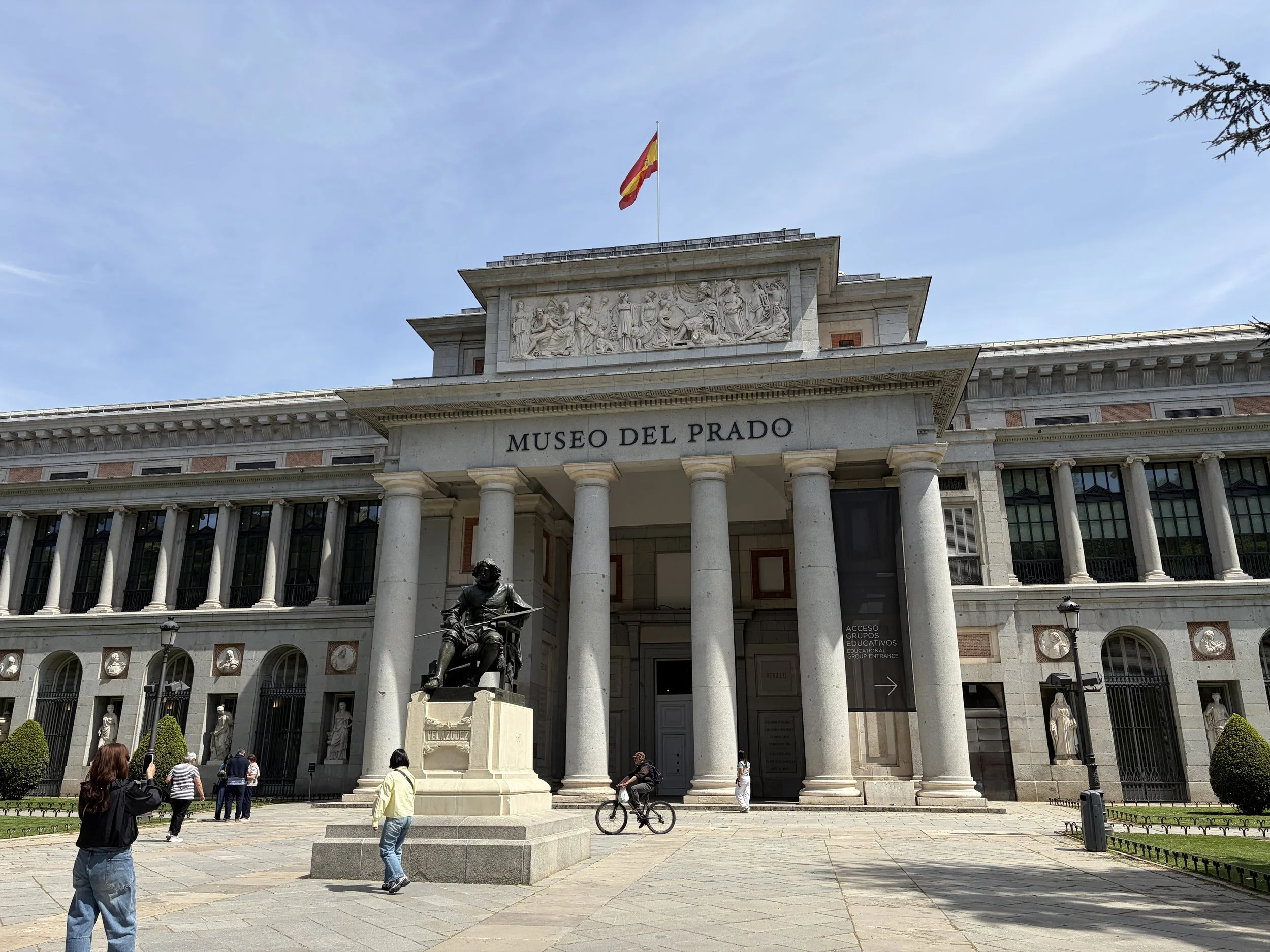
Prado Museum
Day 1
After a leisurely breakfast, we met our guide for the week, María Havara of Wild Doñana Tours, and departed Madrid for Extremadura. Our first destination was Embalse de Arrocampo, a complex of wetlands surrounding a large reservoir. Immediately upon stepping out of the van we were greeted by the insect-like song of Savi’s Warbler, which gave us a quick, but very nice look. We also heard and saw our first of many European Stonechats and both Sardinian and Cetti’s Warblers. Gull-billed Terns were fishing out over the open water, and we saw a number of Purple Herons in flight and roosting in the reed beds. A Water Rail called just once or twice from the marsh, but we weren’t able to lay eyes on this skulker. A big surprise for our group was a very close and cooperative Long-eared Owl roosting in a small, dense tree. It was definitely not a bird we were expecting to see on this trip, and this lovely individual kept an eye on us as we all had lengthy looks back at it through the scopes.
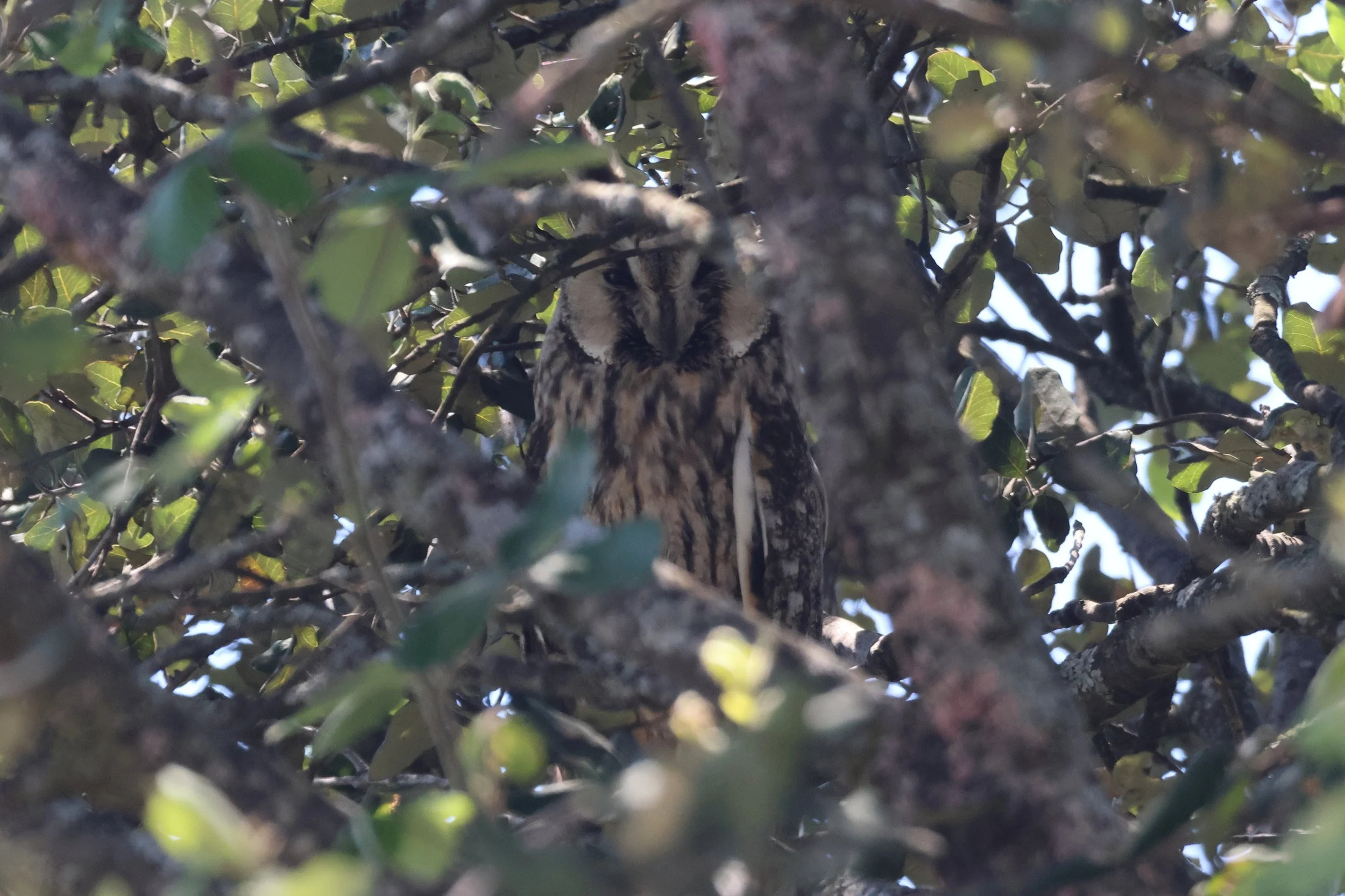
Long-eared Owl
Our hotel for the next four nights, Hospedería de Monfragüe, was situated just outside of Monfragüe National Park. After checking in and having a short rest, we enjoyed a late afternoon walk through the nearby Mediterranean forest. Crested and Thekla’s Larks were common and provided our first identification challenge. A vocal, but shy, Western Orphean Warbler highlighted the other challenge of the trip - getting good looks and identifying the “warblers” of the Iberian peninsula. No easy task!
We also enjoyed our first Rock Sparrows, flyover European Bee-eaters, and a few Woodchat Shrikes, a very regular sight the whole trip. With many wildflowers in bloom, we also took the time to observe several butterfly species, including Painted Lady, Small Heath, and a magnificent Spanish Marbled White.
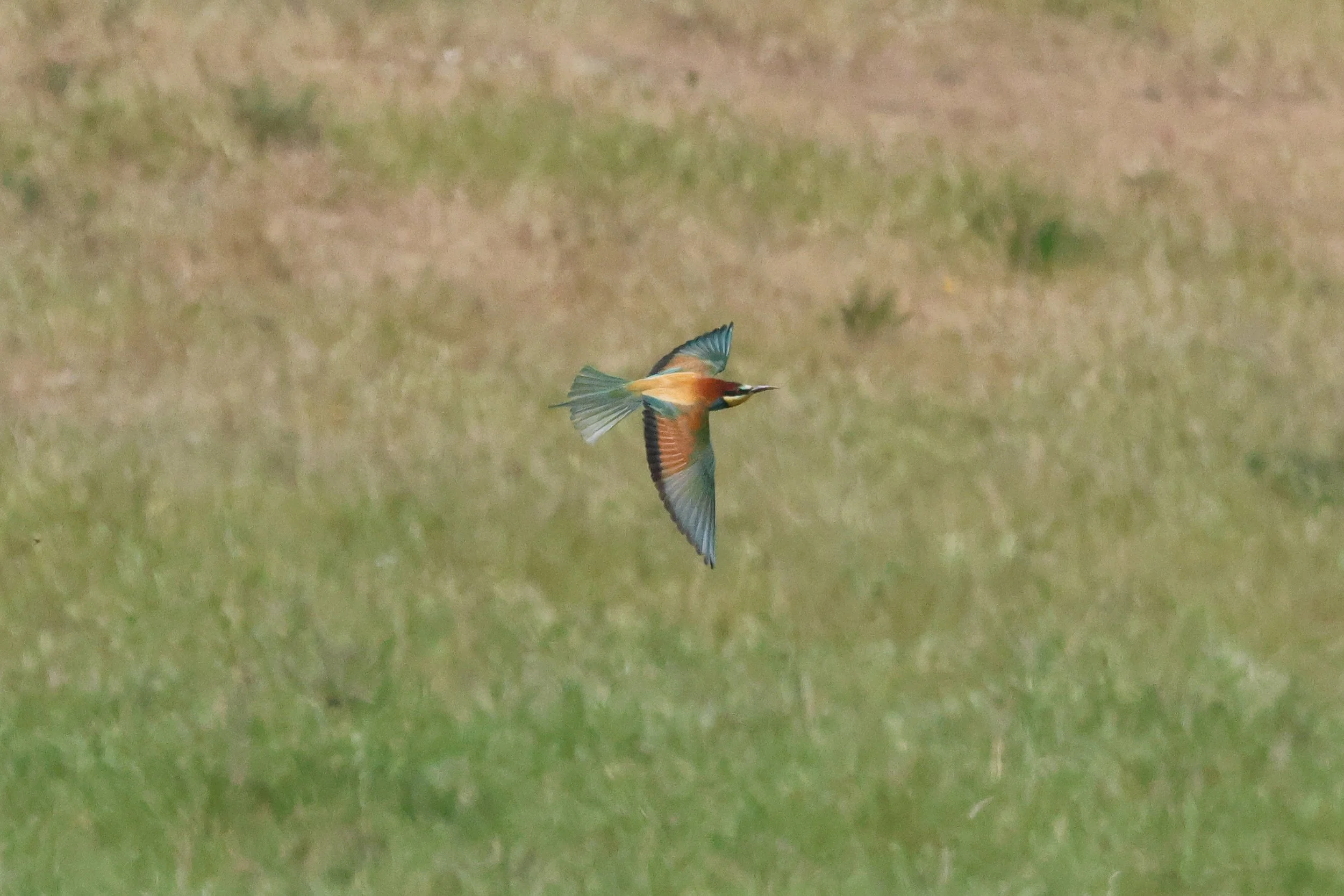
European Bee-Eater
Day 2
The next morning, we departed our hotel early and headed to the Plains of Cáceres. Our first stop was an overlook of the bucolic landscape where we watched the sunrise and scoped a Red Fox and several roosting Eurasian Griffons and Cinereous Vultures in the surrounding grasslands. The main road that we birded in the morning was surrounded by lush meadows where Calandra Larks sang and displayed constantly. From one vantage point along the road we had a scope look at a roving gang of Great Bustards as they strode through the grasses. The pleasant song of the Common Quail accompanied us as we continued down the road. We found a spot where we ate breakfast as we watched European Bee-Eaters and waited to see if a Spanish Eagle would enter or leave the nest that María spotted. This area also gave us opportunities to watch both Black-bellied and Pin-tailed Sandgrouse as they flew over the plains. Driving back, we had a quick look at a Greater Whitethroat before stumbling upon a Whinchat perched on a wire. Our last of the many exciting sightings here was a male Little Bustard standing proudly and displaying on a patch of rock in the expansive fields.
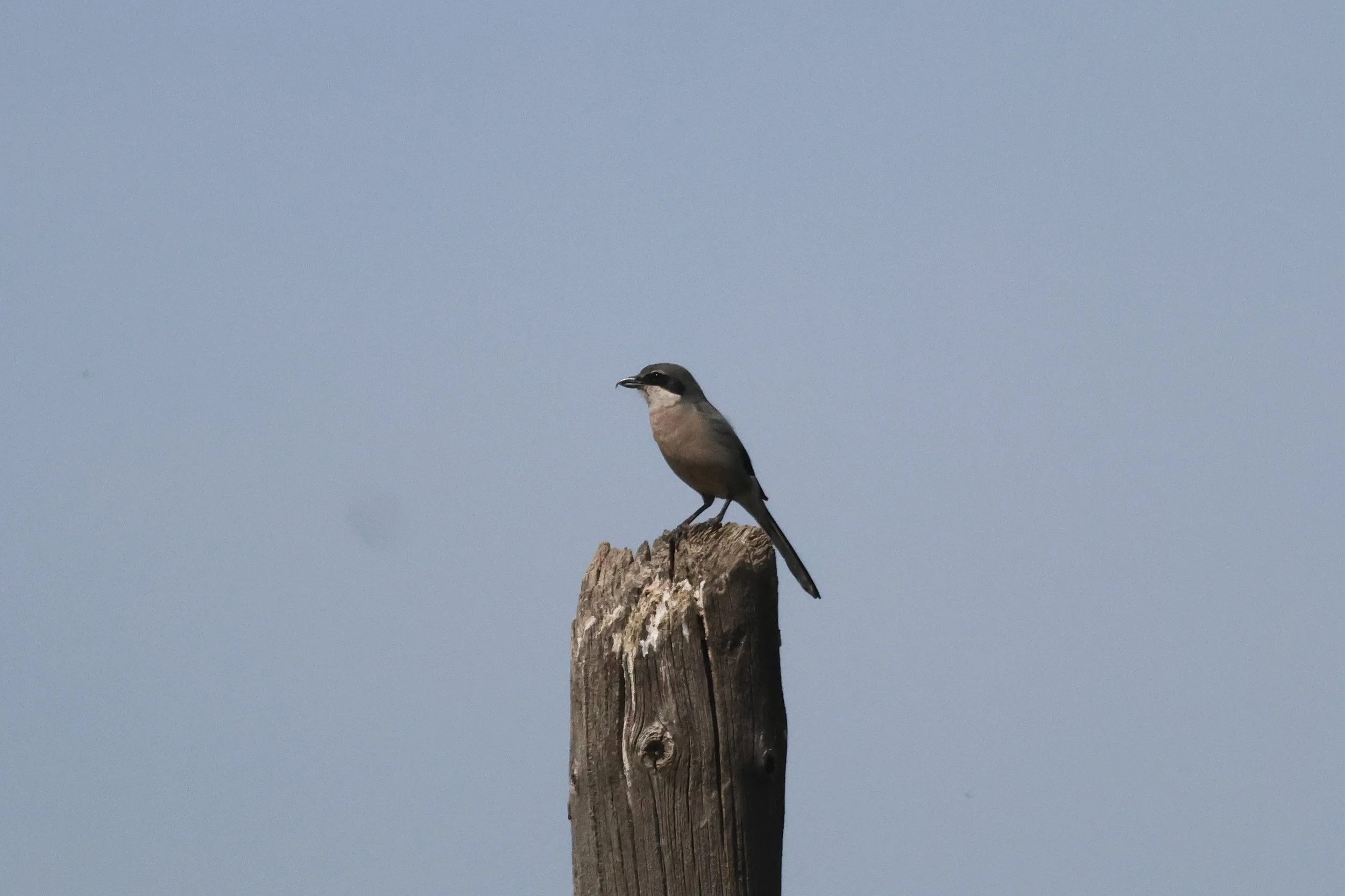
Iberian Gray Shrike
After a coffee break in the nearby town where we watched Western House-Martins visiting their nests, we made a stop at a scenic bridge over the Río Tamuja. There we saw some of our only Little Ringed Plovers of the trip, as well as White Wagtails and Eurasian Crag-Martins. Additionally, this spot was highlighted by a Black Stork soaring overhead and a brilliant view of a Cirl Bunting.
The next portion of the morning involved cruising around some roads and spotting open-country birds like Iberian Gray Shrikes. Red-legged Partridge and Greater Short-toed Larks strode along the ground and a series of nest boxes on telephone poles housed Eurasian Jackdaws and even a Little Owl! We had a distant view of our first Montagu’s Harrier and got to see our only European Roller perched nicely in a shrub. With lots of time in the van, we were happy to take a walk to some farm ponds to look for a Garganey. It was unfortunately not present, but Black-winged Stilts, Great Crested Grebes, and a Red-crested Pochard made it worth the hike.
After a relaxing and well-deserved picnic lunch in the shade, we headed to a reservoir where we saw Common Nightingale, a Cetti’s Warbler, and had a brief glimpse of a Western Bonelli’s Warbler, before arriving at the water. Both Black and White Storks soared overhead. The reservoir had a marvelously entertaining group of European Red-rumped Swallows foraging near the outflow. On our drive to the next body of water to check, we saw another Little Owl and a Green Sandpiper standing in a small stream. Finally, after a full day of birding, we headed back to the hotel for dinner and rest!
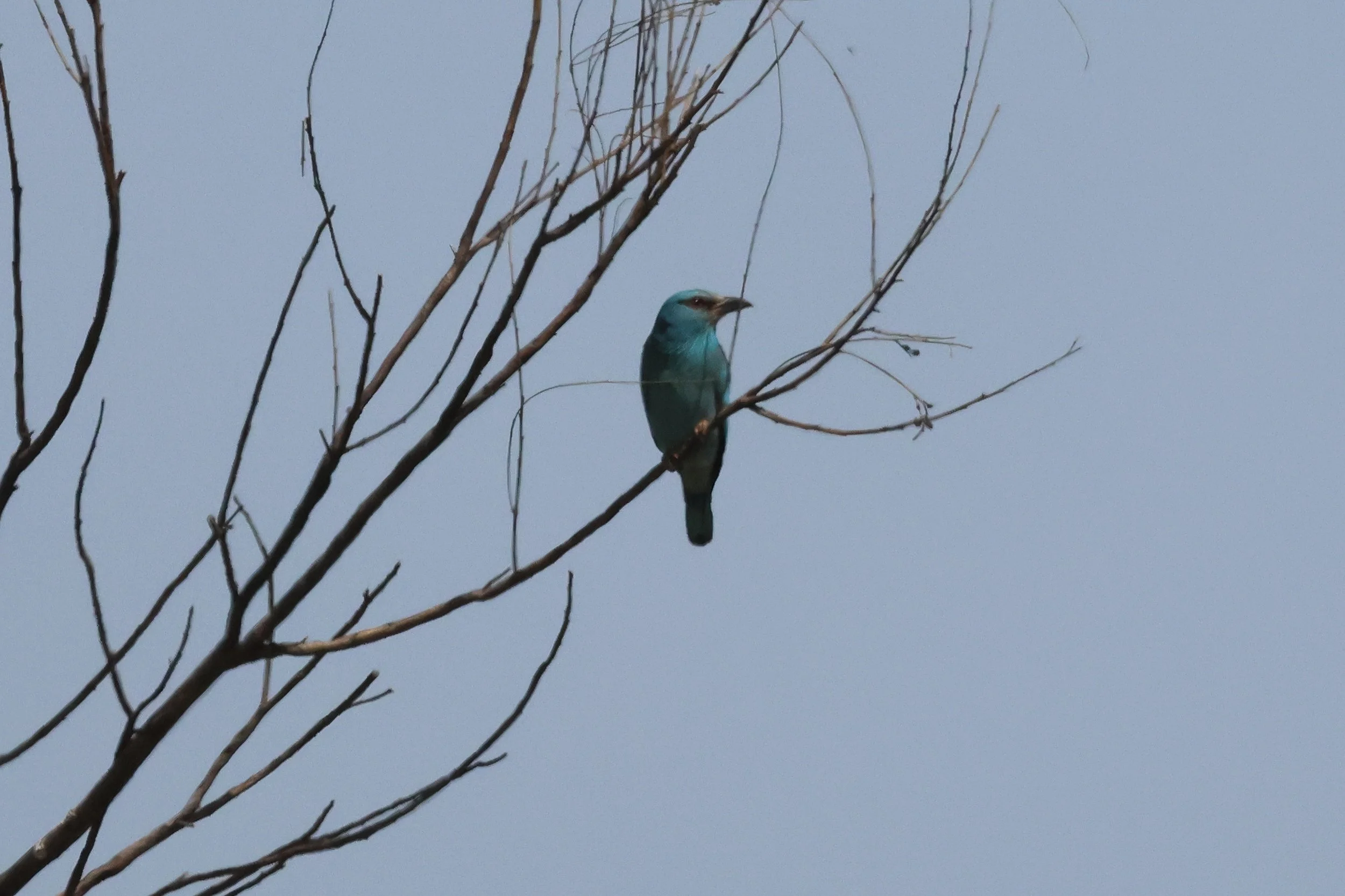
European Roller
Day 3
Monfragüe National Park is one of the premier national parks in Spain, and this day was dedicated to exploring it thoroughly. It is known for its dramatic scenery and great concentration of raptors. We observed three species of vulture (including a nesting Egyptian Vulture and many Eurasian Griffon chicks) and three species of eagle - Bonelli’s, Booted, and Short-toed Snake-Eagle.
Our first stop was especially exciting. Close up Eurasian Griffons and Black Storks flew in to their nests on the cliff faces, and we enjoyed a vocal (and visible!) Eurasian Wren, Black Redstart, and Blue Rock-Thrush. Sam celebrated a birding milestone, his 1,500th species - a Rock Bunting - which showed well foraging along the roadside.
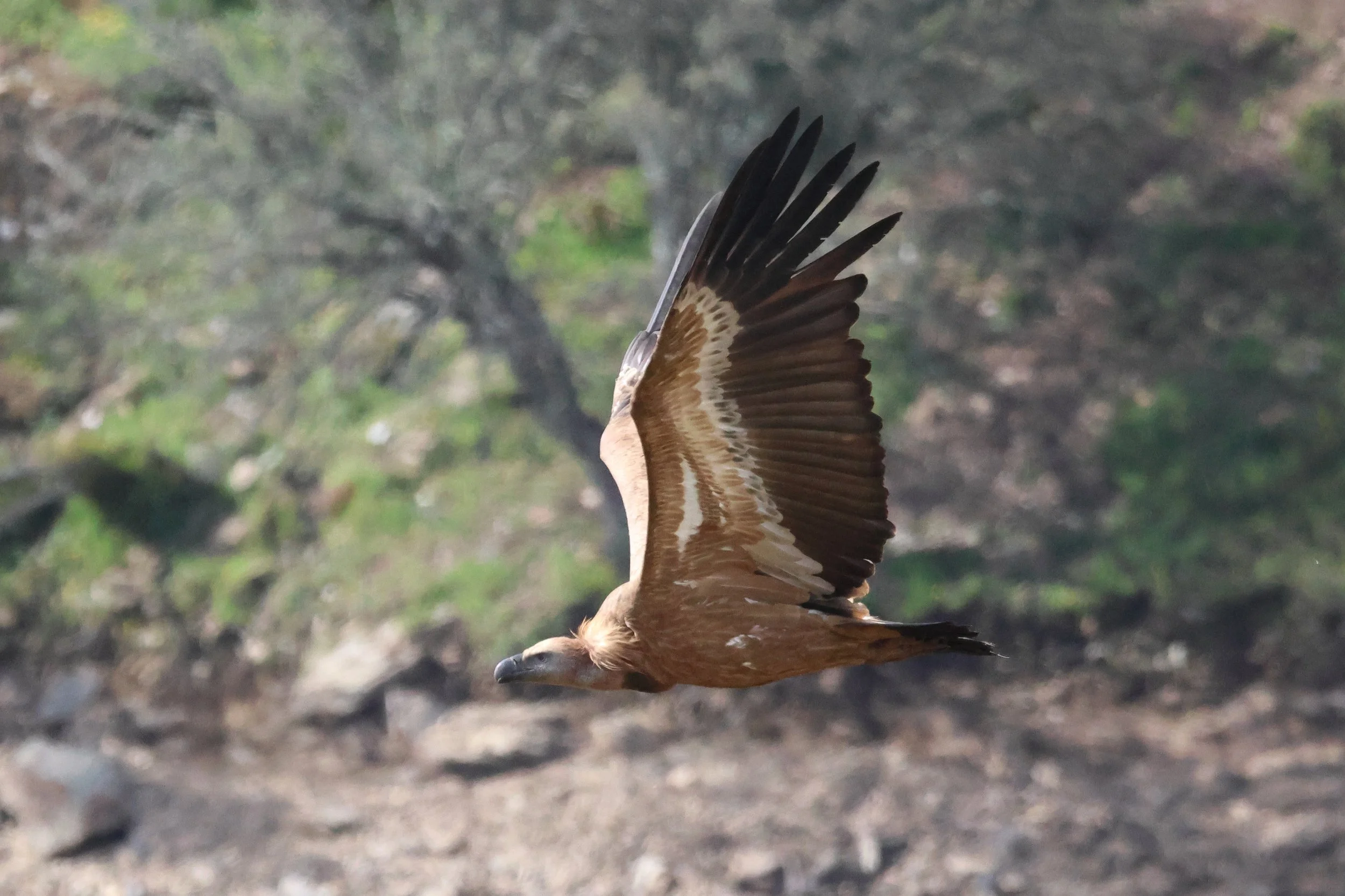
Eurasian Griffon
After lunch we explored a quiet road through a dehesa - an open forest type managed for livestock, hunting, and cork harvest. But is also an important habitat for birds, which were plentiful, albeit a bit elusive. We heard our first Eurasian Golden Oriole and Common Cuckoo, but we didn’t get satisfying looks at either. Wood Lark and Mistle Thrush were more obliging, although also a bit skittish.
A refreshing coffee, tea and ice cream break revived us for another stroll in a wooded riparian area, which was surprisingly productive for the heat of the day. Walking slowly down the trail, we had wonderful encounters with several Western Subalpine Warblers, a nesting pair of Short-toed Treecreepers, European Robin, and a single Hawfinch. After hearing many, we finally had stunning looks at a Common Nightingale singing in a dense tangle.
Our day was not over yet, however! After a short siesta, we took an evening stroll at the Castillo de Monfragüe, ruins of a fortress originally built by the Moors in the 9th century. We had great views of the surrounding countryside, with Eurasian Griffons soaring by and even some hill-topping butterflies - False Ilex Hairstreak and Red Admiral. Voted most photogenic herp of the trip was a very obliging Algerian Sand Racer!
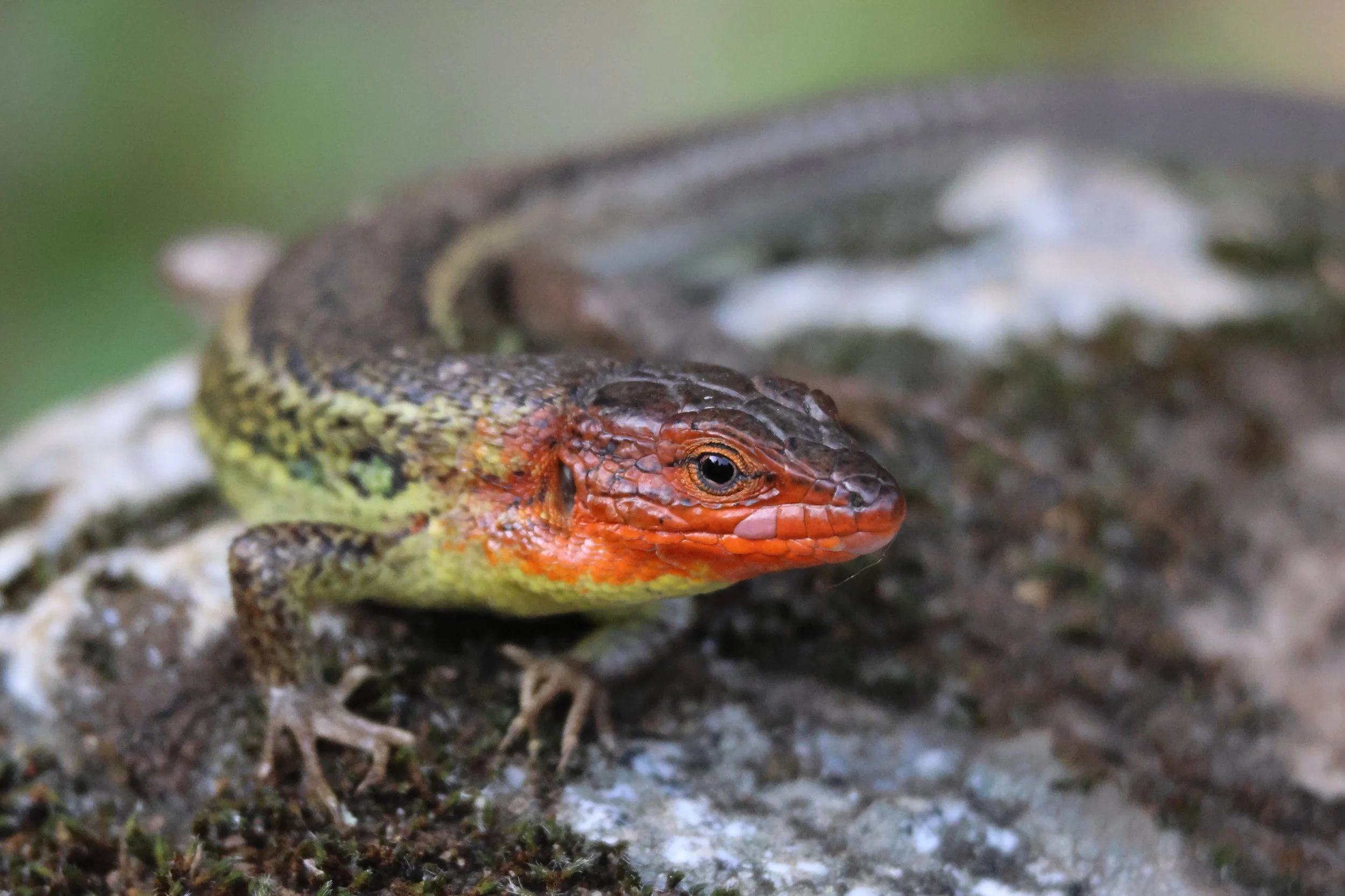
Algerian Sand Racer
Day 4
With another full day of birding the steppes of Extremadura ahead of us, we departed before dawn and headed for the Puentes de Don Francisco over the Río Almonte. There, our main target was Black Wheatear which we searched for high and low with no luck. Thankfully, our first Alpine Swifts made for a memorable experience, and the second lookout we tried, higher above the river, yielded our first sighting of European Turtle-Doves.
We cruised along more roads through the expansive plains with sightings of Common Hoopoe, yet another Little Owl, Western Marsh-Harriers, and our first Common Greenshank. When we got to our main birding road for the morning, the wind had picked up and the weather cooled off. We took shelter in a blind and between scanning from the wind-protected wooden structure, and slowly patrolling the road, we observed Red-legged Partridges, several species of larks, and had excellent views of both species of sandgrouse. Raptors were a prominent attraction with the only Golden Eagle of the trip making an appearance, a female Montagu’s Harrier flying by, and a colony of Lesser Kestrels to admire.
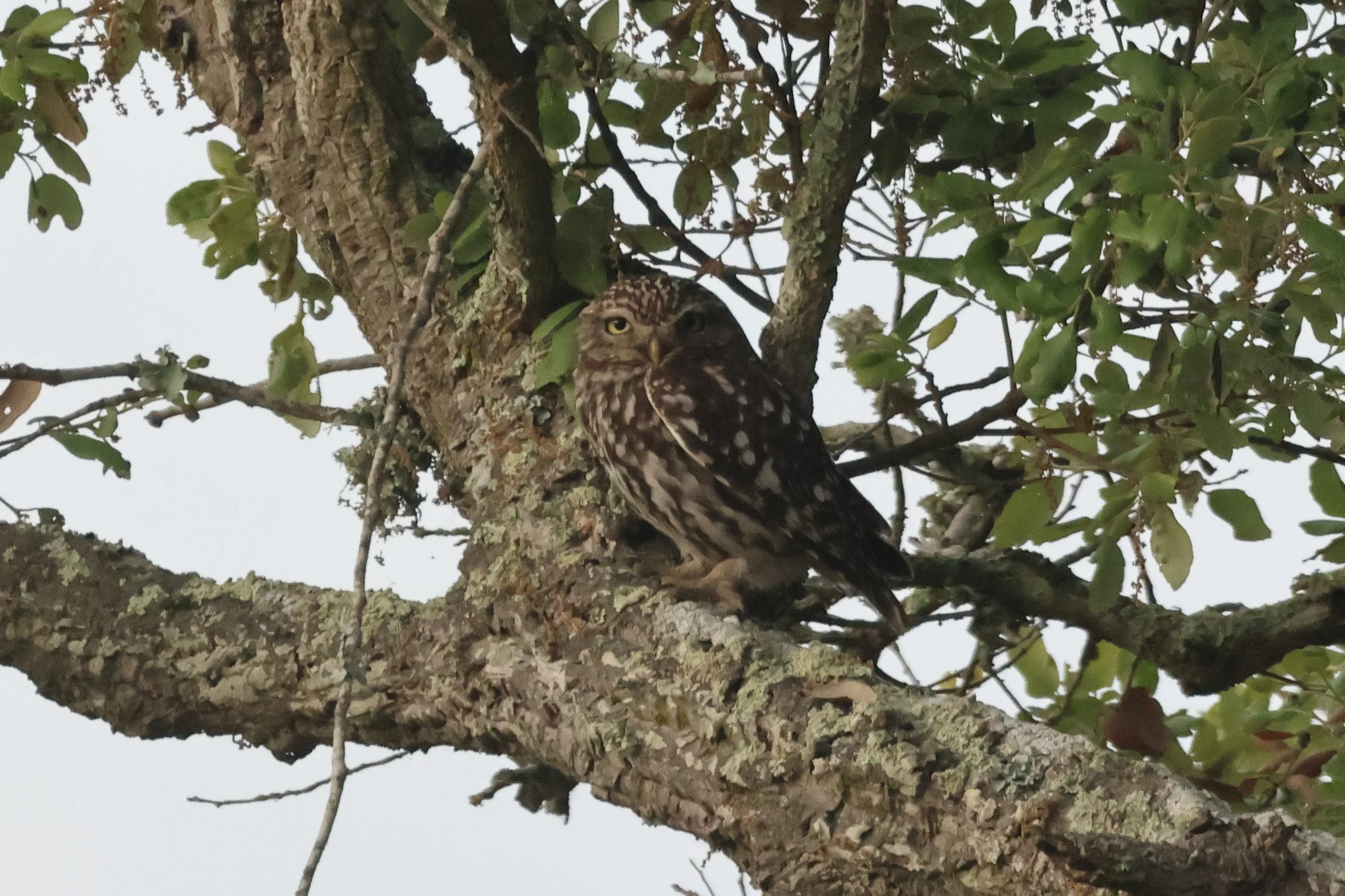
Little Owl
After a break for lunch and coffee, we enjoyed a nice drive through some more open country. We saw what was arguably the most scenic White Stork colony of the trip, which was on an old building surrounded by stunning farmland. An auspicious sighting of a pair of Northern Wheatears on a rocky outcropping in the surrounding meadow was an excellent way to end the scenic drive.
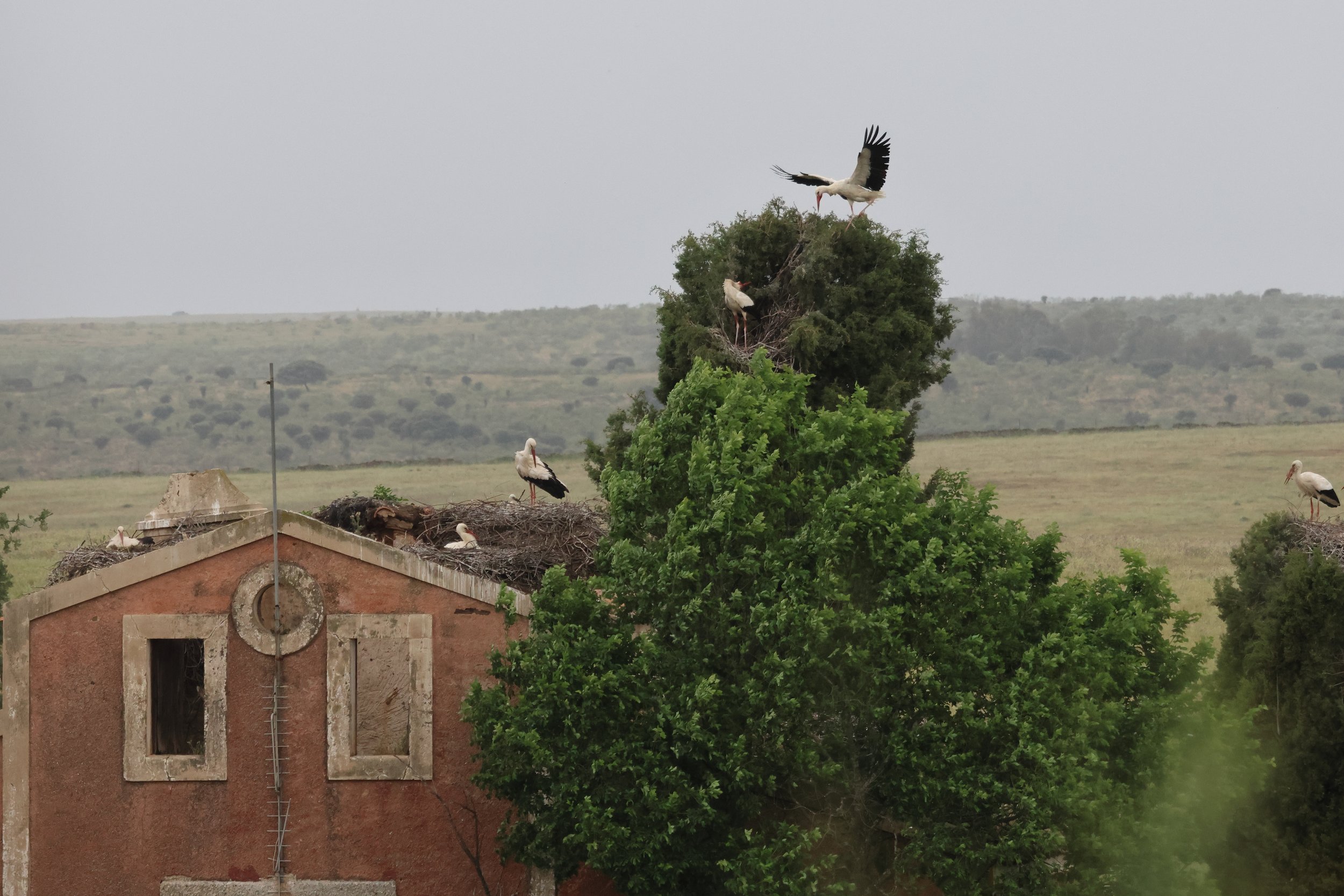
White Stork Colony
For the evening, we ventured back into Parque Nacional Monfragüe where we made a beeline for the dehesa where we had previously seen Mistle Thrush. The Common Cuckoo was singing again and we could hear it from quite a distance. After tracking its sounds all the way down the road, we finally got a beautiful view of it perched up singing from the top of a tree. The “little ones” treated us well in this area with more sightings of Mistle Thrush, a near-constant serenading from the Eurasian Golden Oriole, as well as nice looks at Wood Lark. As we walked towards the stunning griffon-nesting cliffs that we had visited before, a European Turtle-Dove cooed softly. When we got to the river, a Common Kingfisher entertained us from the opposite bank. At the cliffs, we sat and ate dinner watching griffons feed their chicks and hoping to get a glimpse of an Eurasian Eagle-Owl. Once the sun had set, there was no sign of the owl so we packed up and went back to our hotel for the night.
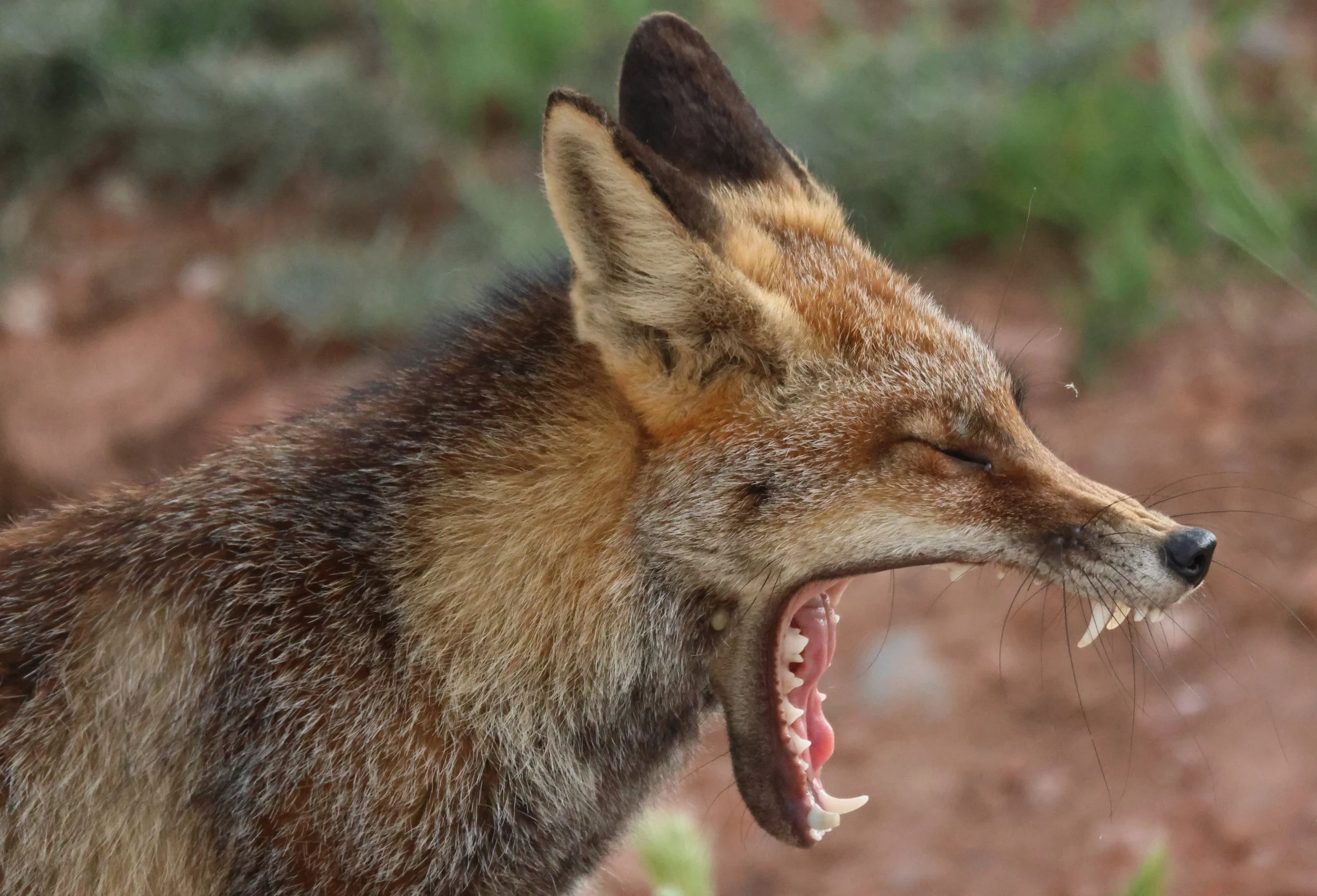
Red Fox
Day 5
We said our good-byes to Monfragüe this morning, as we made our way to our next hotel, Ardea Purpurea Lodge, near Doñana National Park. Our first stop of the day was Embalse de Alange-Presa, where we observed our only Black Wheatears of the trip, a pair surveying their domain from the towering rocky outcrops.
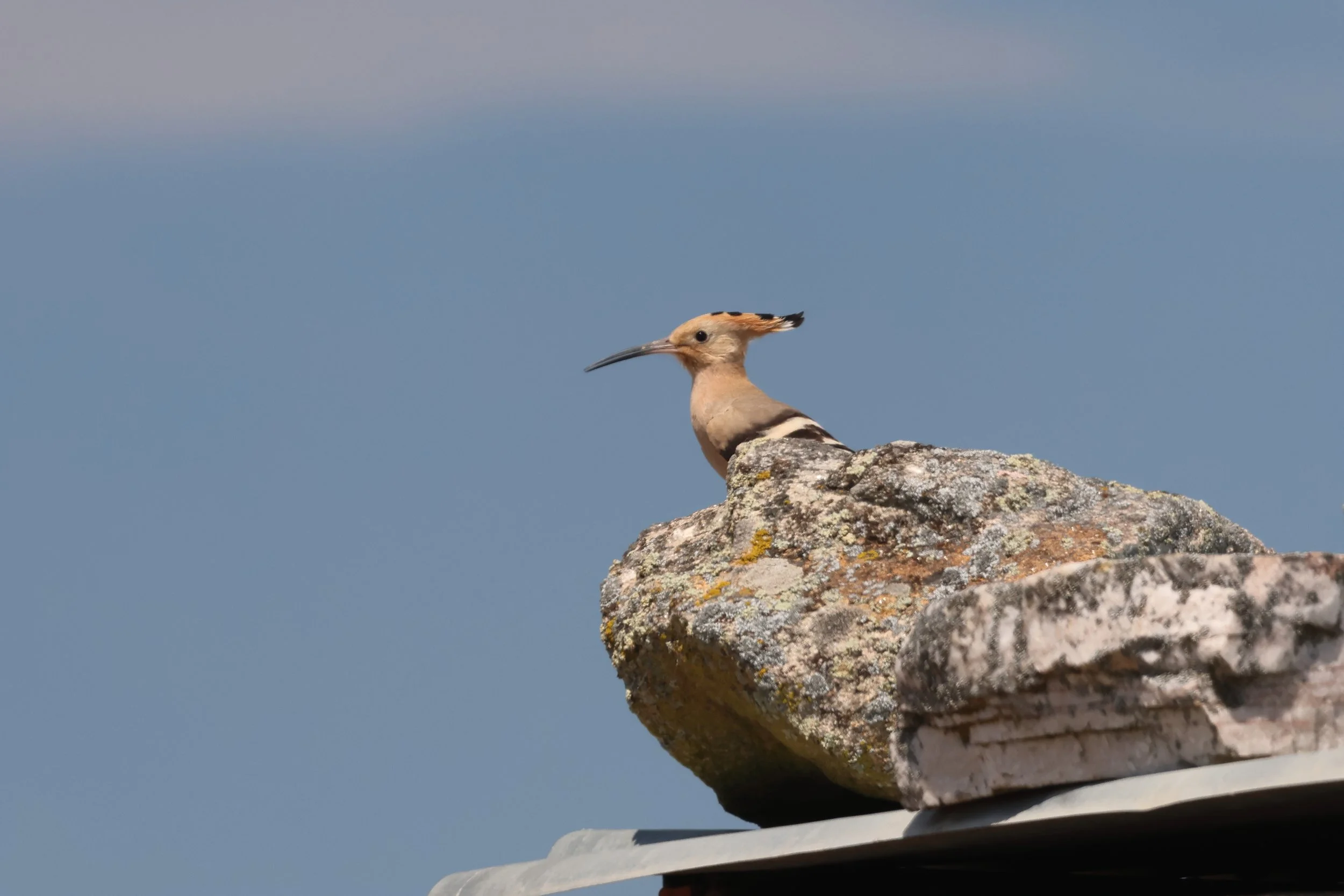
Common Hoopoe
Another highlight of the drive was watching a pair of Black-winged Kites going about their business in a roadside dehesa. One member of the pair was seen carrying nesting material and the kites perched cooperatively in the Holm’s Oaks for us to admire. María’s favorite Spanish bird!
Our picnic du jour was at yet another reservoir, Embalse de los Molinos. This spot offered a nearly 360 degree view, perfect for scanning for Iberian Lynx which are relatively common in the area. We spent a couple of hours birding and looking for the lynx, which never materialized. Although there was no sign of the elusive feline, some nice birds kept us entertained. Some close - like the abundant Red-legged Partridge and nesting Great Crested Grebes; some distant - like a Eurasian Golden Oriole and an Iberian Green Woodpecker calling from the hillside on the other side of the reservoir. This wide, open landscape was also excellent for raptors. A group of four Spanish, one Booted, and five Short-toed Snake-Eagles soared overhead, giving us great looks.
After checking into our lodge and a fine dinner, a late evening walk on the sandy road leading out of town morphed into some quality nocturnal birding. It wasn’t long after dusk when a Red-necked Nightjar was heard calling nearby. We crept closer and the bird flew up and over our heads. Sam was quick with his flashlight and phone and managed to get a video of the nightjar, showing the white band across the wings. As we worked our way back to the hotel, a Tawny Owl started calling, also close by. We didn’t expect to see the owl, but María spotted it in the lower branches of a Stone Pine. We enjoyed a staring contest with the owl for a solid minute, before it flew off in the direction of another calling Tawny Owl.
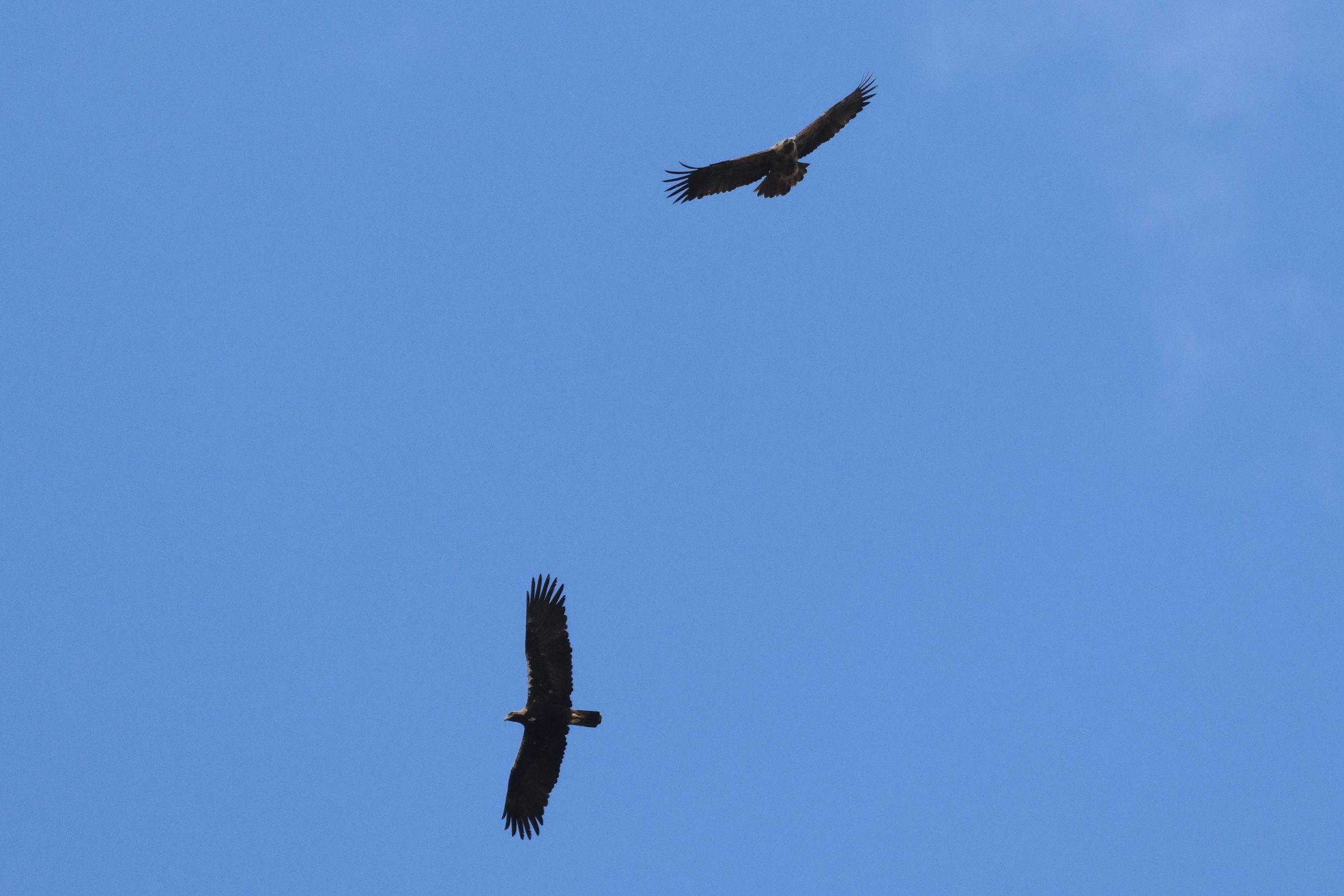
Spanish Eagles
Day 6
Our first full day at Doñana National Park was incredible! We headed out early and after a coffee stop, we drove through the historic town of El Rocío where beautiful white buildings with hitching posts out front line sandy streets. We got to the visitor center on the edge of Charco de la Boca, where the lagoon was brimming with Greater Flamingos, Graylag Geese, Black-winged Stilts, and Pied Avocets. Both Common and Great Reed Warblers sang from the marshes and a Little Bittern made a brief appearance as it flew up into view before diving back into the reeds.
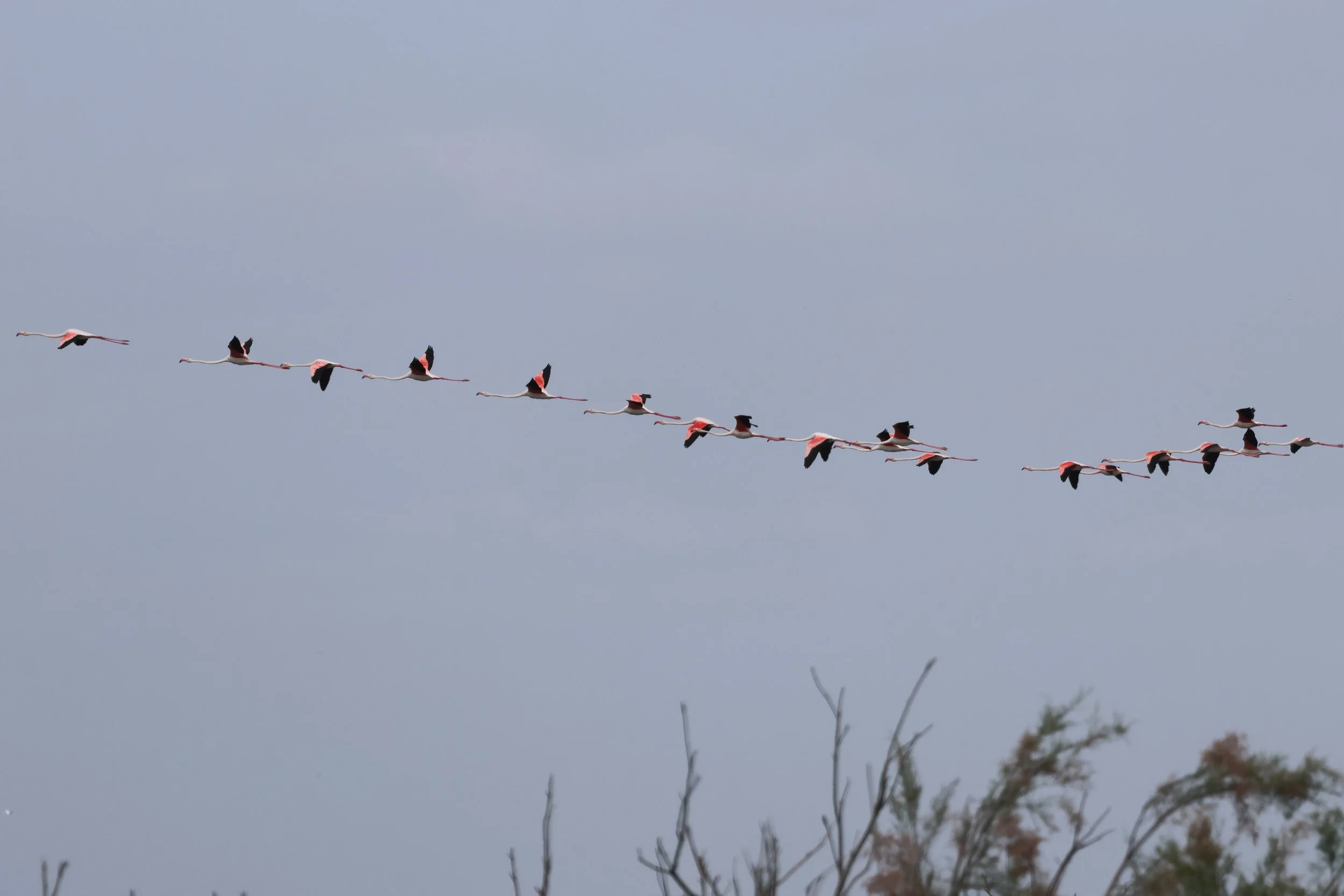
Greater Flamingos
We then loaded onto a larger bus with a local guide to access a restricted part of Doñana. We skirted along the edge of town spotting some Common Waxbills on the way before entering a dehesa. Forest birds abounded and we saw European Serins, Spanish Sparrows, European Goldfinches, and European Turtle-Doves. As we drove, we even glimpsed a mob of Iberian Magpies chasing a Tawny Owl through the trees.
Once we left the forest behind, we were cruising along a dike with marshes on either side. We had amazing views of Europe’s most endangered duck - the Marbled Duck, displaying. Flocks of shorebirds added to the excitement with Little Stints, Dunlin, and Common Ringed Plovers foraging together. Glossy Ibis along with spoonbills, herons, egrets, and flamingoes were everywhere.
Soon we came to a spot where a Spur-winged Lapwing was walking in a pasture right by the road. This mega rarity had been reported to a local rare bird alert group the day before and, after we had mind-bogglingly amazing looks at the bird foraging on both sides of the road, it flew away never to be seen again. Depending on the provenance of a 2025 record, this could constitute a new species for Spain! Further along, we saw our first Western Yellow Wagtails, as well as Whiskered Terns patrolling over the marsh and occasionally diving. Great Crested Grebes tended to their young and we spotted our only Eared Grebe of the trip. As we walked along the edge of the marsh, we spotted a pair of Little Bitterns across the road from a bustling and diverse heron rookery with nesting Squacco Herons! We also spotted a Eurasian Penduline-Tit sitting still near its hanging nest. The nearby visitor center featured some productive shorebird habitat, where we got a peep at some Temminck’s Stints.
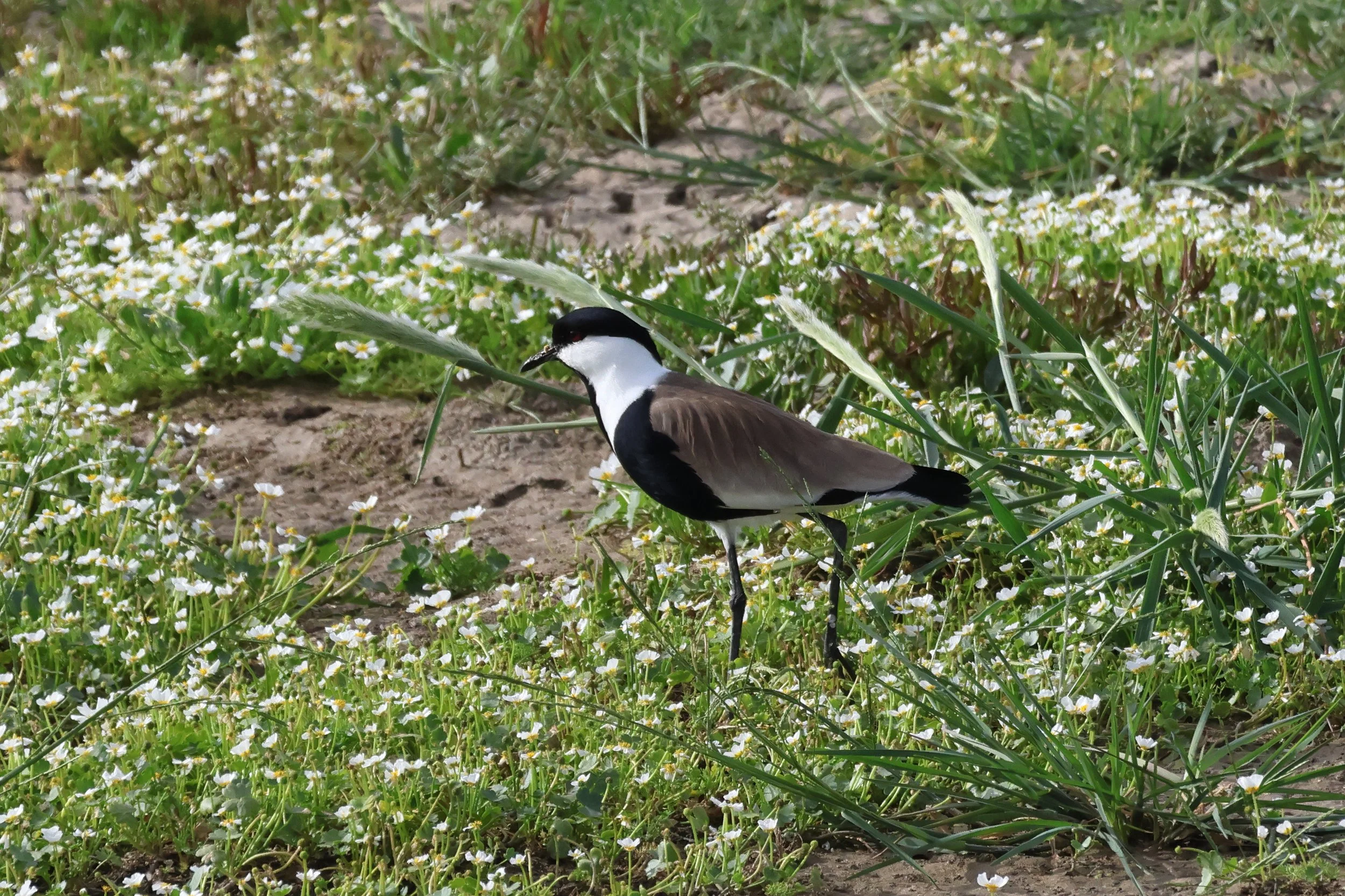
Spur-winged Lapwing
After returning to town we went to a lakeside park where we observed Garden Warblers foraging in trees. After some scanning we saw some shorebirds, including a Ruff and a Wood Sandpiper, all against a scenic background of the town of El Rocío with horses grazing in the lush marshes. Some folks then wandered the town and did some shopping before we all met for a big lunch of a gorgeous paella mixta with a delicious medley of seafood and meat in saffron rice!
After lunch we spent some time in a forest looking for “littles ones” which included Crested Tits, Spotted Flycatchers, Melodious Warbler, Eurasian Tree Sparrows, and more! On the drive back to the hotel we also spotted our first European Greenfinches.
After some needed downtime some folks got back in the van for a lynx search. We drove along sandy roads and, in between sightings of the birds that were becoming increasingly familiar to us, we found some scat left by the elusive Iberian Lynxes. We staked out a rabbit-filled clearing and ate dinner to the sound of a Common Cuckoo singing as we scanned for the cat. Without any luck, we packed up and drove back in the dark with stops for vocalizing Little and Tawny Owls and a Red-necked Nightjar flying in front of the vehicle. As we were passing a man herding a flock of goats using several dogs, Sam noticed some eyeshine and in a flash we were looking at an Iberian Lynx sitting calmly at the edge of the forest in the illuminating beam of a flashlight. Right as the rare creature had totally resolved and we realized what we were looking at, the goats and dogs caught up and the lynx was gone. Still, with a successful sighting under our belt, we went back and got into bed happy.
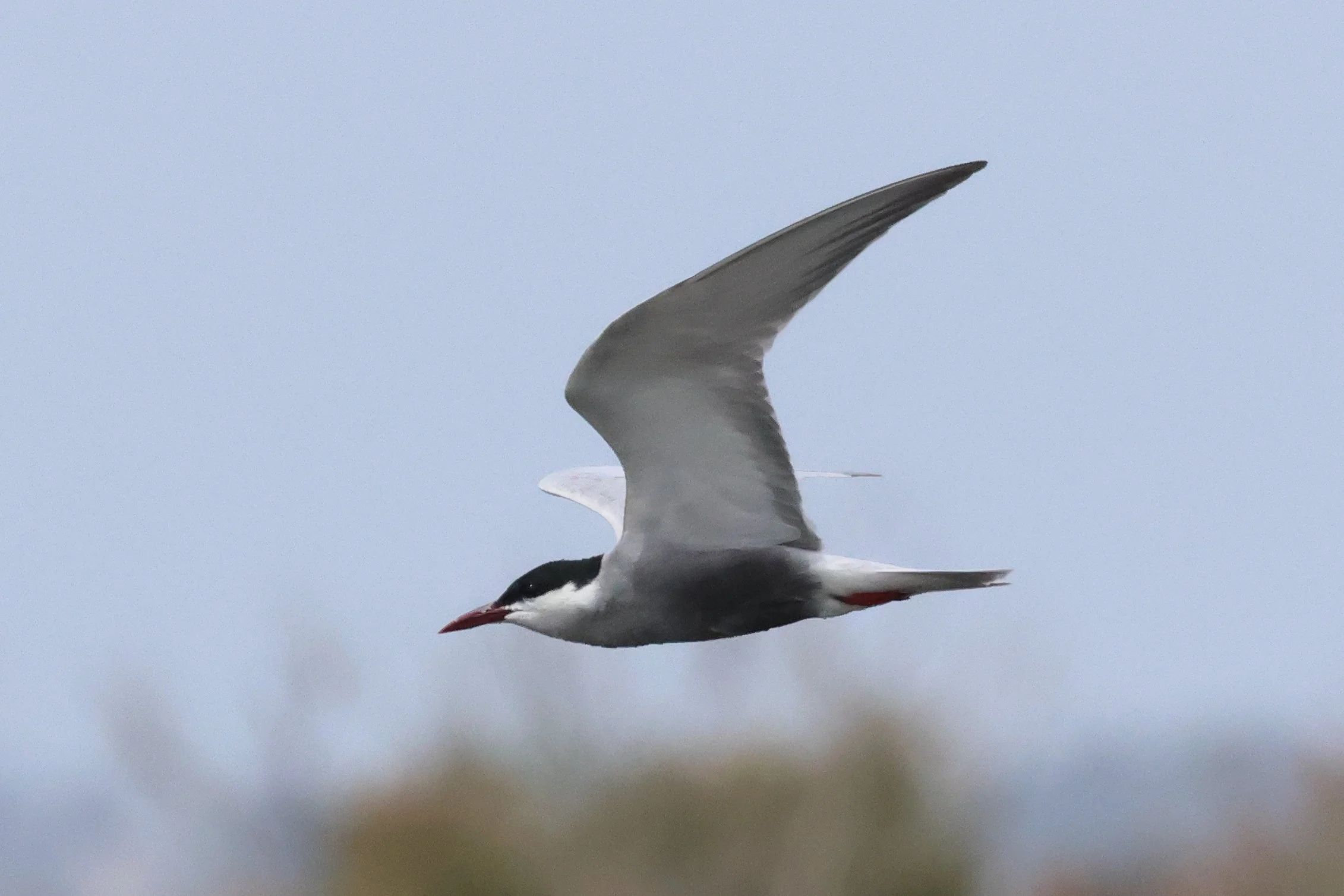
Whiskered Tern
Day 7
Our second day dedicated to exploring Doñana was another one packed with activity. We concentrated on the central areas of Doñana in the province of Seville. Dehesa de Abajo was especially productive for waterfowl. Here we observed our only Garganey (flying away) and Ferruginous Ducks of the trip, along with Marbled Ducks, Northern Shoveler, Gadwall, and Common and Red-crested Pochards. The area was also a haven for exotics/escapees, with Swan Goose, Greater White-fronted Goose (perhaps just a lingering bird rather than an escapee?), Graylag Goose (both domestic and wild), and the ubiquitous Egyptian Goose. We also had perhaps our best and closest looks at a very obliging and vocal Common Reed Warbler. Another highlight was a huge Stone Pine hosting an incredible rookery of Eurasian Spoonbills, Gray Herons, Great Egrets, and White Storks. A literal tree of life!
The middle portion of the day was spent driving the dikes through Doñana, past marshes, ponds, and dried-up rice fields. It took some effort looking through all the Eurasian Coots to find a Red-knobbed Coot. Once we did, however, we had splendid looks at a family group at close range in the marsh. We enjoyed one of our best shorebird flocks of the trip, with a large flock of Common Ringed Plovers and Curlew Sandpipers, scores of Eurasian Whimbrel, Common Sandpiper, a couple of Wood Sandpipers, and two Spotted Redshanks in breeding plumage! A lone Collared Pratincole did a fly-by, leaving us longing for longer looks. Whiskered Terns were much more obliging, giving us close and innumerable looks in good light.
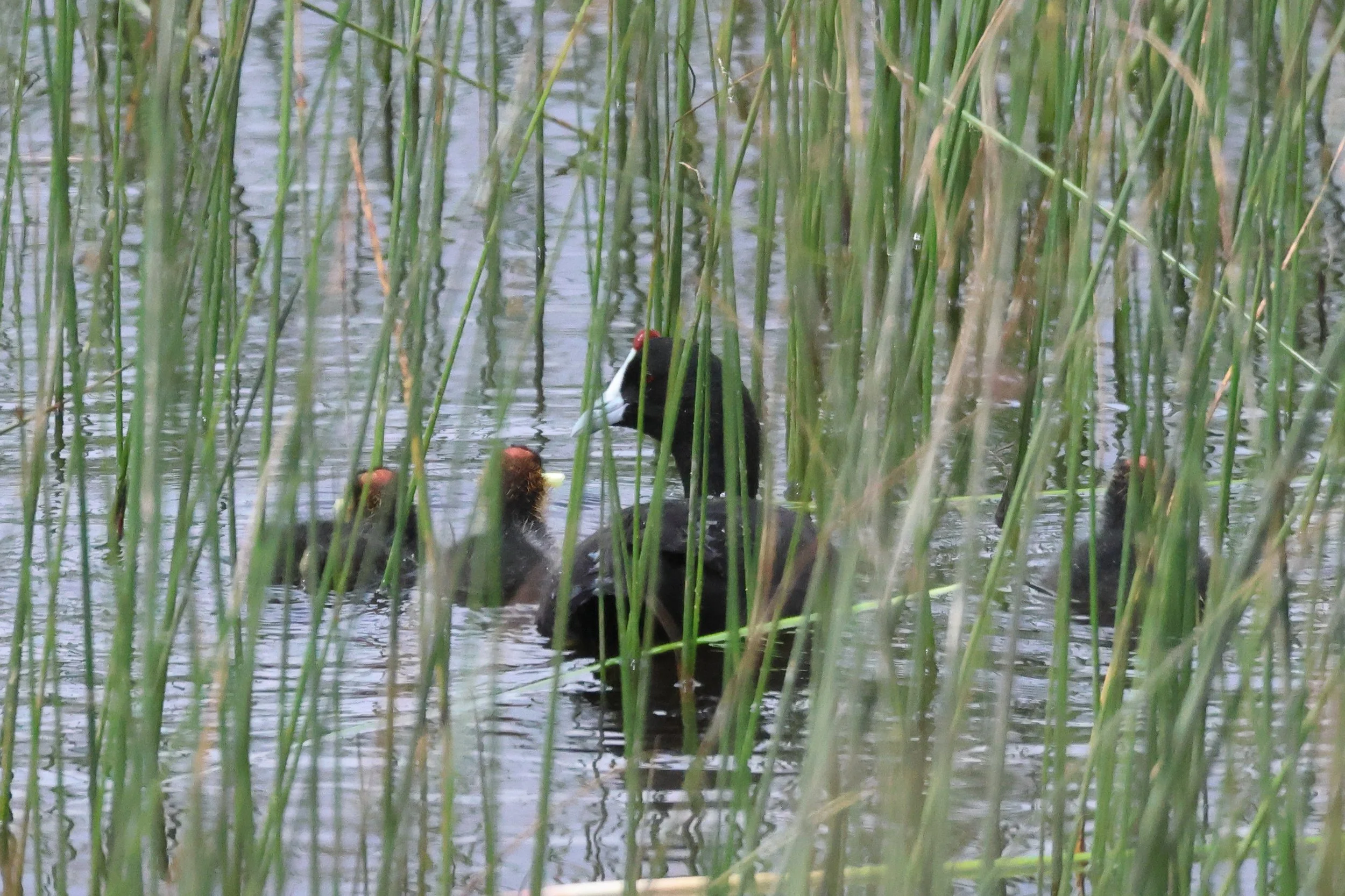
Red-knobbed Coot
Although we were already riding high, María had another surprise in store for us. Out in the marsh was yet another (!) White Stork on a massive stick nest. But this one was different, it had company. Underneath the stork nest was a nest box with a special occupant - a Western Barn Owl! We were in luck because the owl was awake and staring out of the box, much to the delight of our group.
How could the day get any better? How about going to look for Eurasian Wryneck? Our last stop of the day was Corredor Verde del Guadiamar in Aznalcázar. This protected park had probably the largest trees we had seen up to this point. Our targets here were the Eurasian Wryneck and Lesser Spotted Woodpecker. It wasn’t long before we heard the drumming of the woodpecker, but this Downy Woodpecker-equivalent never really showed itself. However, the wryneck put in an appearance giving us great looks. A member of the Woodpecker family, the wryneck appears more like a nightjar in terms of plumage. When it was perched it showed the classic woodpecker posture, but the bird primarily feeds on ants on the ground, much like a flicker in the U.S.
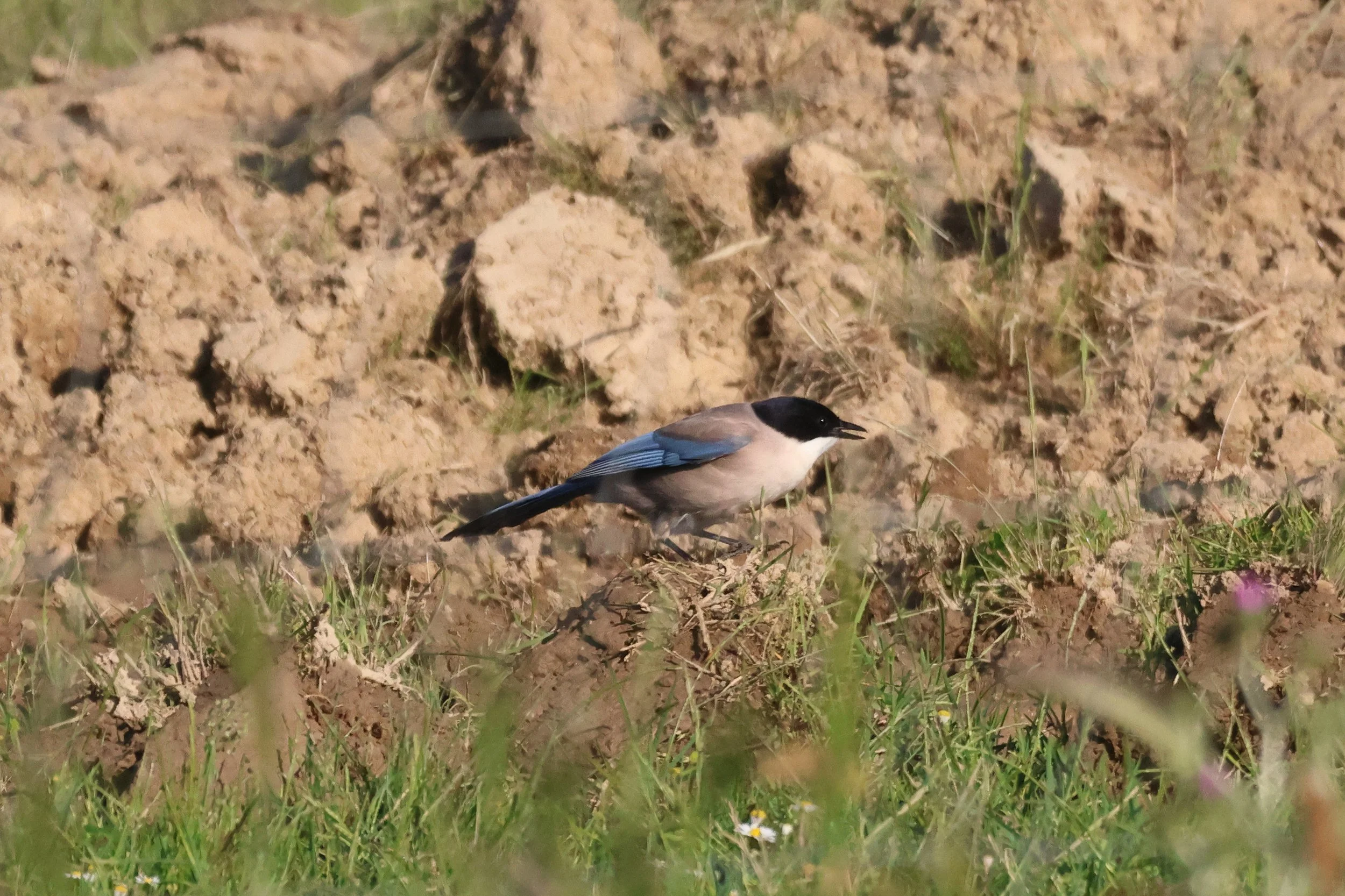
Iberian Magpie
Day 8
We got an early start on the day, leaving from the hotel before the sun rose. On two occasions we spotted Red-necked Nightjars on the road as we navigated our way towards Seville. The highlight bird of the diurnal part of the drive was our only male Montagu’s Harrier, which we had great looks at from the bus.
Once we entered Cádiz province, we birded around a rural mosaic landscape looking for early Rufous-tailed Scrub-Robins. While none had returned to their nesting grounds yet, other countryside birds were around, including Eurasian Linnets.
Our next stop was the wetlands and scrubby plains around southern Doñana. In one area, the combination of open plains and water features provided us with excellent diversity. We saw a couple of striking Spectacled Warblers and carefully studied some Mediterranean Short-toed Larks as they displayed and occasionally landed within view on the ground. A small group of Western Yellow Wagtails included one of the subspecies flava, a migrant that will nest in northern or central Europe. The nearby wetlands were also productive, featuring our first Kentish and Black-bellied Plovers, as well as Little Terns, and a Common Redshank. We also had one final encounter with some flyby Pin-tailed Sandgrouse.
Not too far away, another wetland complex was brimming with bird life. Common Shelducks walked through the marshes and a flock of Common Redshanks showed off their stunning wing pattern as they flew around. While we were looking through the shorebird flocks, a songbird hopped up onto a fence which was a gorgeous adult Ortolan Bunting, an incredibly scarce migrant and a wonderful treat to see! Further along, a large lagoon housed the first sleek-looking Slender-billed Gulls of the trip which were elegantly foraging on the surface of the water. A big treat here was also a lone Lesser Flamingo, a rare visitor from Africa, that Chip spotted among a large flock of Greater Flamingos. Its brighter pink plumage and smaller stature made it recognizable amongst its relatives even from a distance.
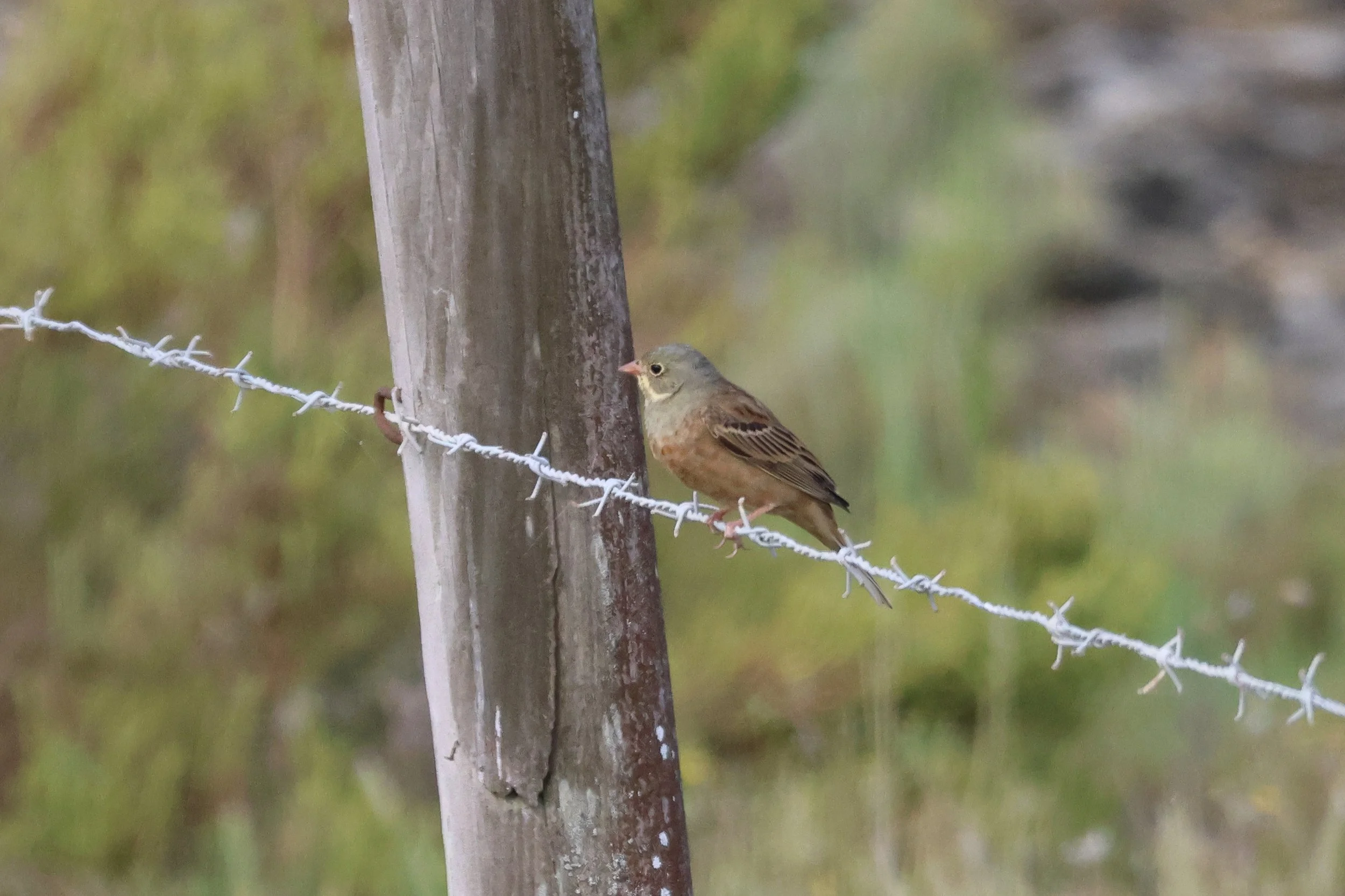
Ortolan Bunting
After a bathroom break, we stopped at a trash-ridden road with ponds on either side. Despite the less-than-pristine surroundings, we had amazing looks at both female and male White-headed Ducks, a very endangered duck species in Spain! The pond also was home to Little Bittern, Little Grebe, and a Western Swamphen that was grabbing reeds with her feet and biting pieces off to feed to her little fluffy chicks.
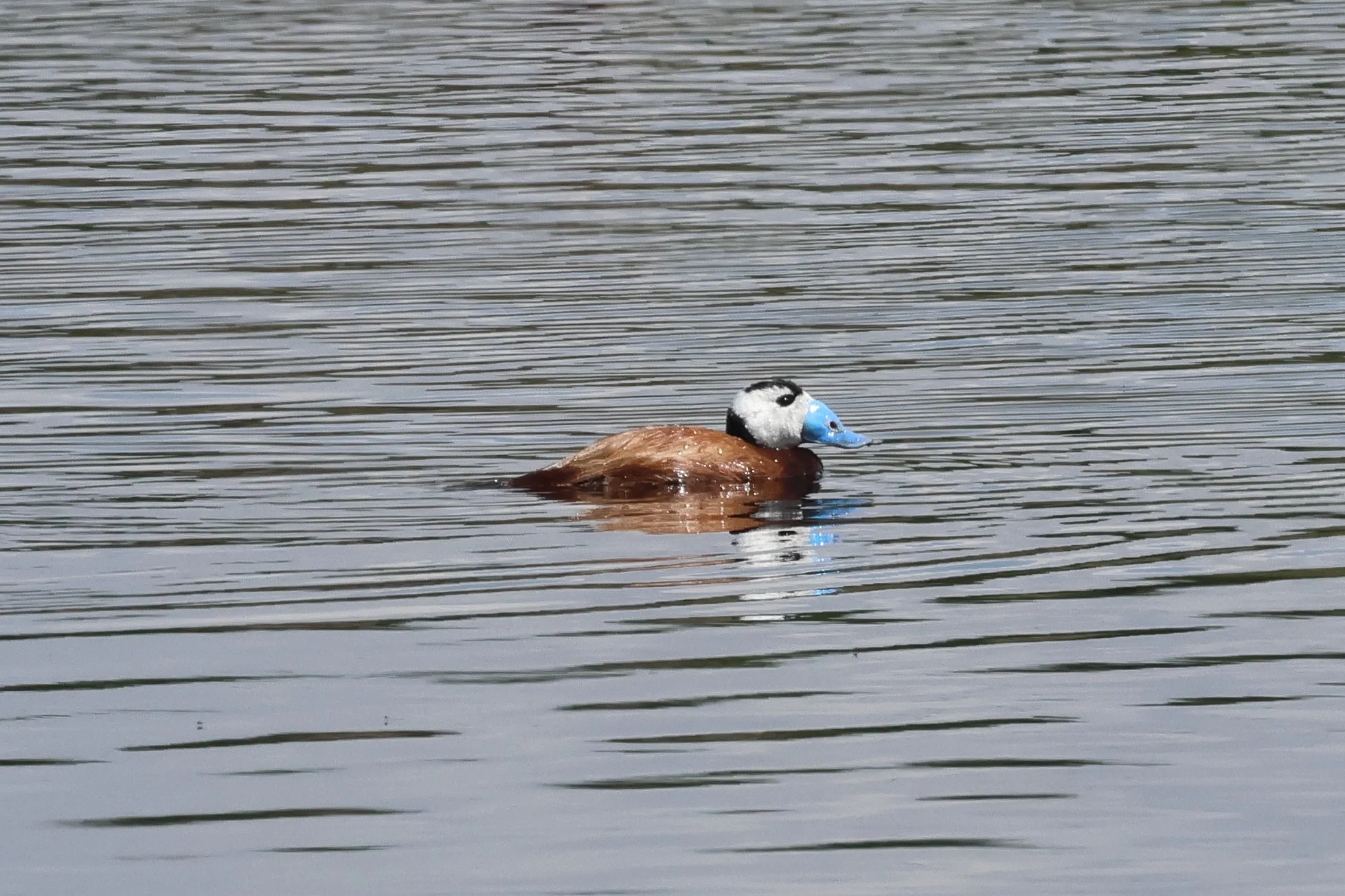
White-headed Duck
Our next location was Salinas de Bonanza, salt flats that migratory waterbirds love for foraging. While we ate our own lunch we watched a massive flock of Curlew Sandpipers feeding in the shallow water, while Slender-billed Gulls fed further back. Our only Osprey of the trip was sitting on the ground nearby and we fawned over tiny Pied Avocet chicks that were just a few days old!
After lunch we made a few more stops including a swift colony at the port in Chipiona, which is one of the few places Little Swifts nest in Europe. A big highlight for everyone were some cliffs with a dozen nesting pairs of Northern Bald Ibis, a species remarkably close to extinction that is being actively conserved through a captive breeding program. Seeing this so-ugly-they’re-cute ibis feeding its chicks gave us all hope for their future!
Our last official stop of the busy birding day was a lagoon surrounded by pastureland in Barbate. There, we were quickly blown away by the nesting Collared Pratincoles who flew right by our awestruck group in between bouts of copulating on a sandbar or incubating their eggs. A close European Pied Flycatcher was a pleasant bonus at this stop and, after scanning through more shorebirds, Linda spotted a Eurasian Thick-knee. After having been teased by this species all trip we finally got some sustained views! Shorebirds were a theme of the day with even more species present at this spot, including a pair of Black-winged Stilts with chicks and nesting Little Terns.
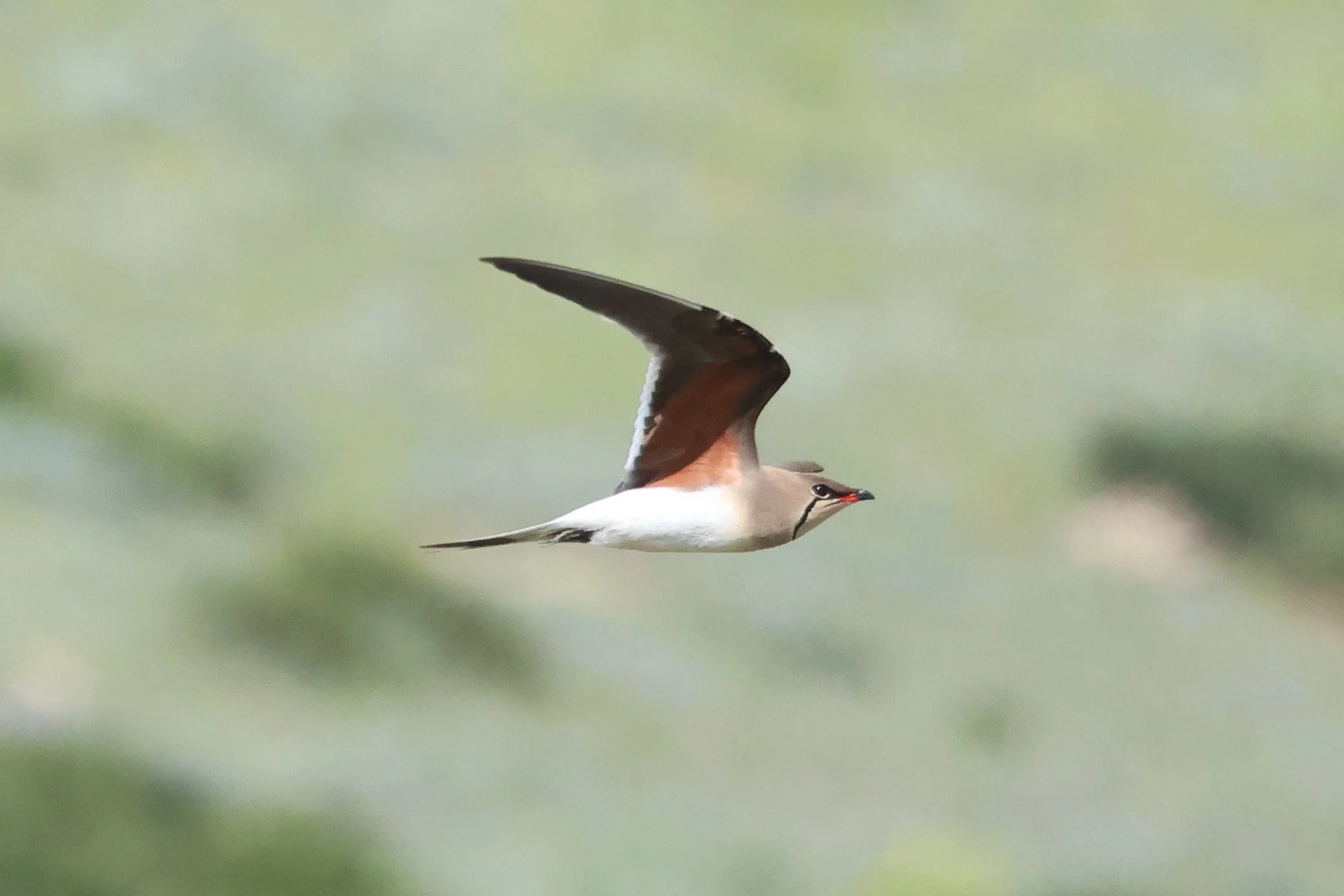
Collared Pratincole
After a long day of seeing all the birds we set out to see, we settled into our last hotel in Tarifa which featured wonderful views of the surrounding landscape with the Atlantic Ocean meeting the Mediterranean Sea at the Straits of Gibraltar, and Morocco in the distance.
Day 9
Our last full day of birding was a windy one! The morning started out a bit calmer, which aided our search for “the little ones” at Observatorio de La Peña in Tarifa. Our ramble around the rocky, green pasture yielded mostly stonechats and Sardinian Warblers, but we also found our first European Honey-Buzzard of the day, and we lucked into some Tawny Pipits just as we were leaving. The honey-buzzard is a fascinating raptor which feeds primarily on wasps and hornets, including their larvae and pupae. According to the species account in Birds of the World, the honey-buzzard follows wasps in flight to locate their nests, watching them from an inconspicuous perch and sometimes catching them in their air. They’ll also remove wasp and bee nests from trees and/or dig out ground nests with their talons. The honey-buzzards are interesting taxonomically as well, as they’re more closely related to some species of kites than they are to hawks and buzzards.
Birding the coastline proved to be extra blustery, but our first “beach” stop was relatively calm. We had good looks at several shorebirds, including Kentish Plover, Eurasian Whimbrel and Curlew Sandpiper, distant looks at Northern Gannets plunging into the Atlantic, and multiple shearwaters, which went unidentified due to the distance. Another cove further up the Strait of Gibraltar coast was also productive with Ruddy Turnstones, Sanderling and a very cooperative Western Black-eared Wheatear - finally! We also had the opportunity to study three different subspecies of Western Yellow Wagtail including the resident iberiae, another flava, and the British-nesting flavissima.
After lunch we explored Los Alcornocales Natural Park in the hills above Tarifa. “Alcornocales” means Cork Oak grove and, indeed, cork forest was the primary habitat here. We played hide and seek with the wind, but managed to see a good number and diversity of songbirds. We had our best looks yet at Western Bonelli’s Warbler, our only Eurasian Nuthatch of the trip, and close encounters with both Spotted and European Pied Flycatchers. Common Firecrest, Great Spotted Woodpecker, and Willow Warbler were also present but much less cooperative. The cork forest was lovely to explore with Rhododendron and many wildflowers in bloom, butterflies braving the wind, and even some ruins of an old homestead nestled in the woods.
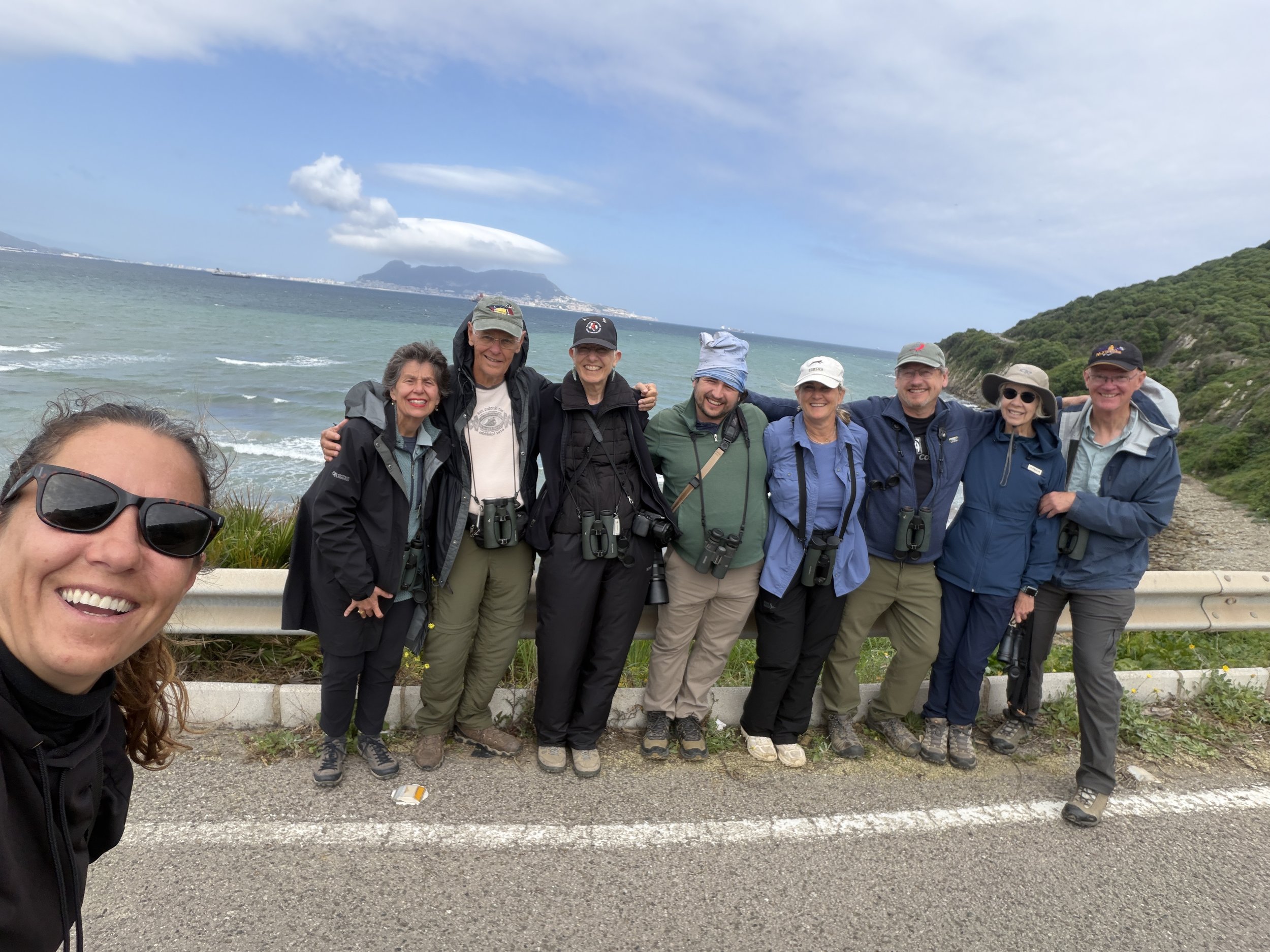
Group selfie with Gibraltar
Day 10
On our final day we woke up and had breakfast before loading into the van to drive to Málaga. We had a few bird sightings of the usual suspect as we drove through our final province. María dropped everyone off at the airport of their hotel. We wished her a happy birthday and said farewell before leaving Spain full of wonderful memories and unforgettable sightings!
An Iberian Peninsula itinerary for March 2027 is coming soon!
OR…