
New Zealand 2026 Tour - From Kiwis to Keas - Field Report
FlyAway Birding teamed up with Wrybill Birding Tours to offer a two-week adventure in New Zealand. Our itinerary covered nearly the whole length of the country, from Kerikeri on the North Island to the famed Stewart Island in the far south. Here is a day-by-day of our incredible trip!
Day 0
After a very long day of travel, just barely keeping ahead of a major winter storm in the US, our group all arrived in Auckland. The Rose Park Hotel, in the Parnell neighborhood, is immediately across the street from the Dove-Myer Robinson Park, allowing for some casual strolls in the park to start observing the local bird life. Sacred Kingfishers ruled the park with up to 5 or 6 birds seen fishing in the waters of Judge Bay or hunting for worms in the grassy, mowed lawns of the park.
At low tide, a pair of Variable Oystercatchers and a lone White-faced Heron foraged along the tide line. Silver (Red-billed) and Kelp Gulls were common, with immatures of both species present and begging from the adults. Naturalized exotic species – Common Myna, Australian Magpie, Eurasian Blackbird - were also common in the park, but there was also a nice smattering of native species, including Gray Gerygone, Tui, Silvereye, and Welcome Swallow. A warm welcome, indeed!
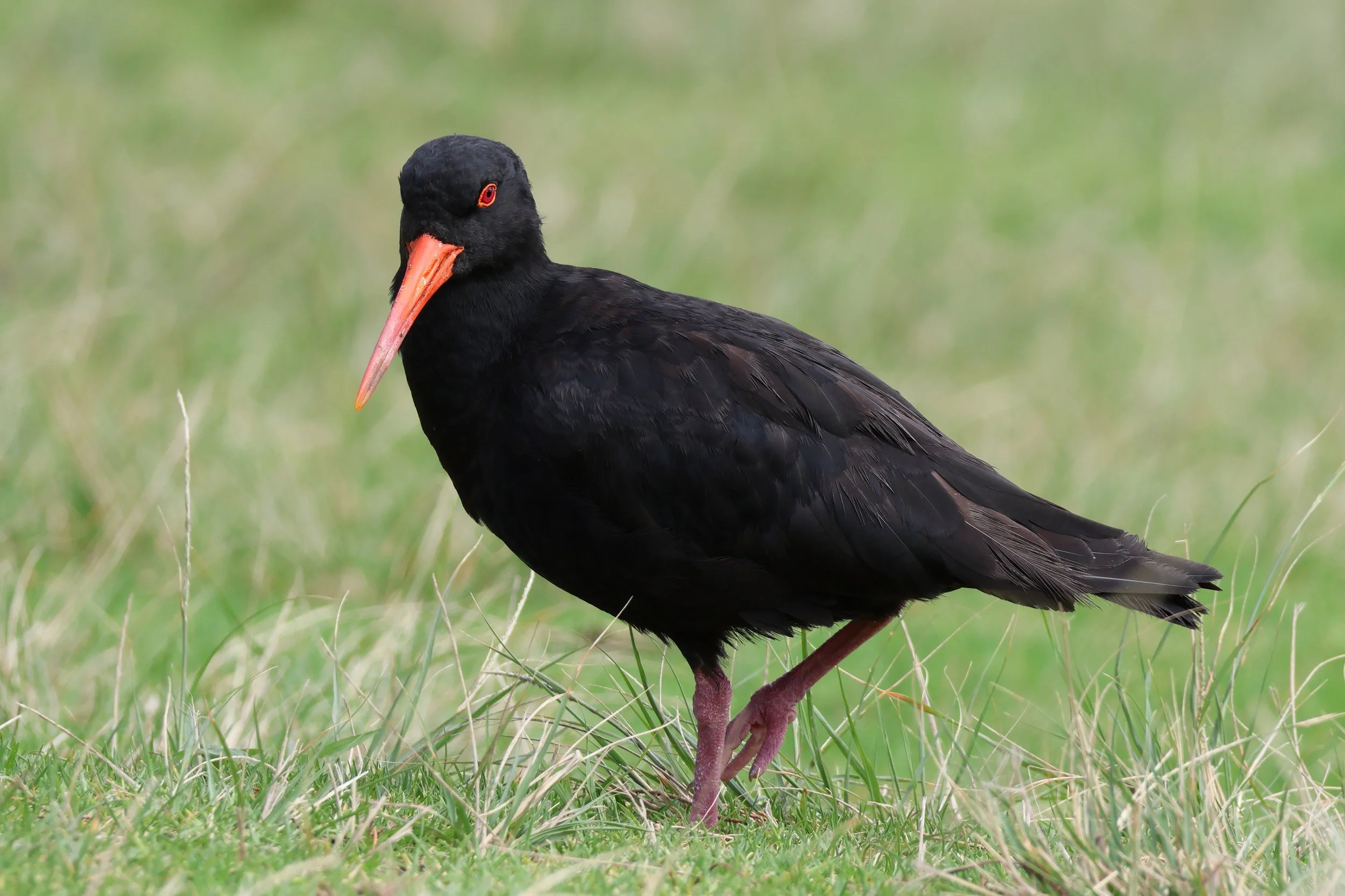
Variable Oystercatcher
Day 1
We enjoyed our first morning of birding at Tawharanui Regional Park, a sanctuary free of rats, cats and other predators, north of Auckland along the coast. Once we passed the gated entrance through the predator-proof wall, our first stop was at a lagoon where we had great looks at Red-breasted (New Zealand) Dotterel, Buff-banded Rail, Paradise Shelduck, and Brown Teal. The teal is a very rare but recovering species of waterfowl, only found on a few predator-free islands in the country.
We also spotted our first New Zealand Kaka of the trip, one of only 3 extant species in the endemic New Zealand Parrot family (Strigopidae). We were introduced to two other endemic families of birds, the Whitehead in Mohouidae (Whiteheads) and North Island Saddleback in Callaeidae (Wattlebirds).
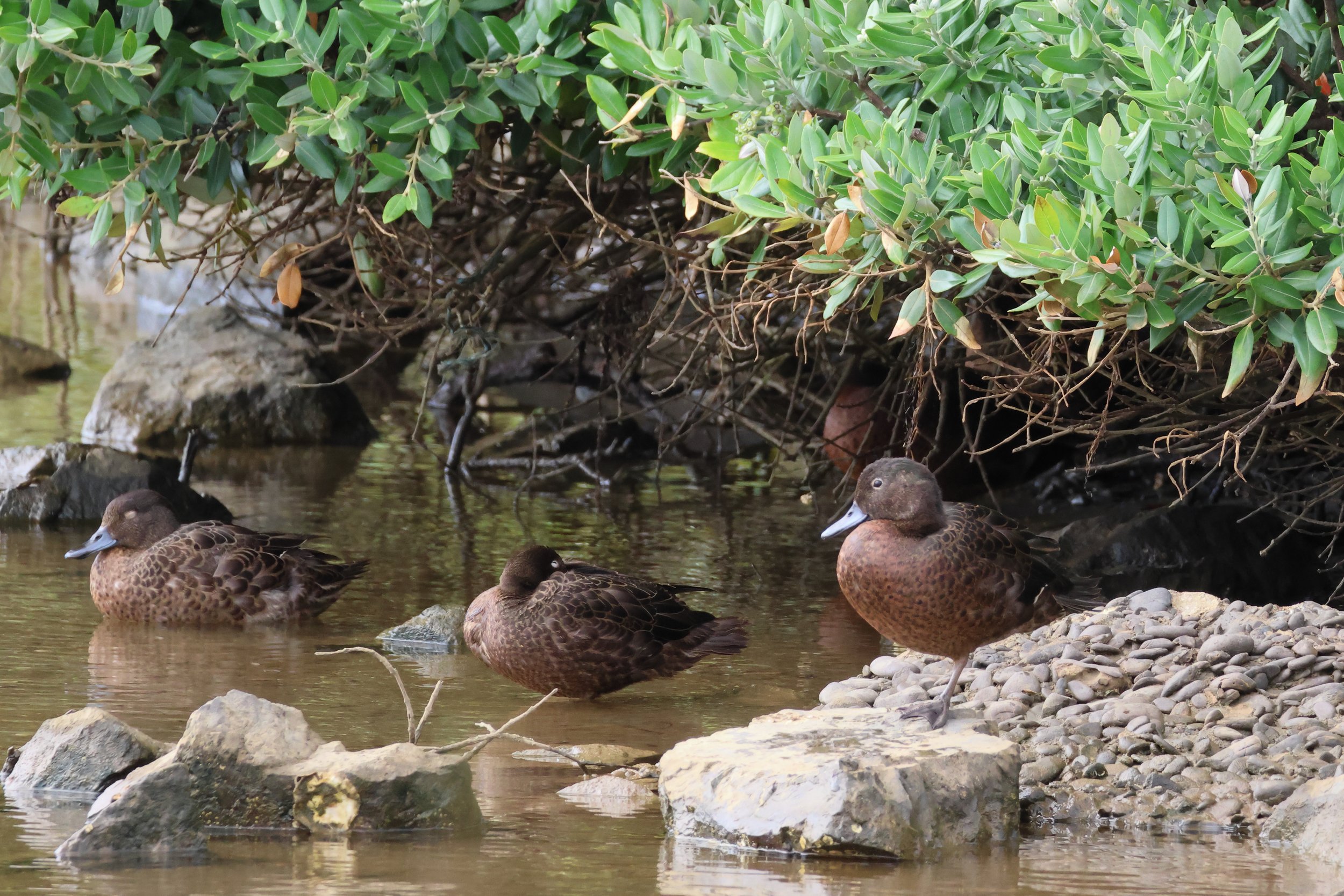
Brown Teal
Another group of birders put us onto a very obliging, fledgling Morepork, which was equally curious about us. This species is the only native owl in New Zealand and we heard many more than we saw throughout the trip. Australian Swamphen were thick in the fields along the road into the refuge. We hit a high count of 184 “Pukeko” on our drive out, but no Takahe, which are scarce in the refuge.
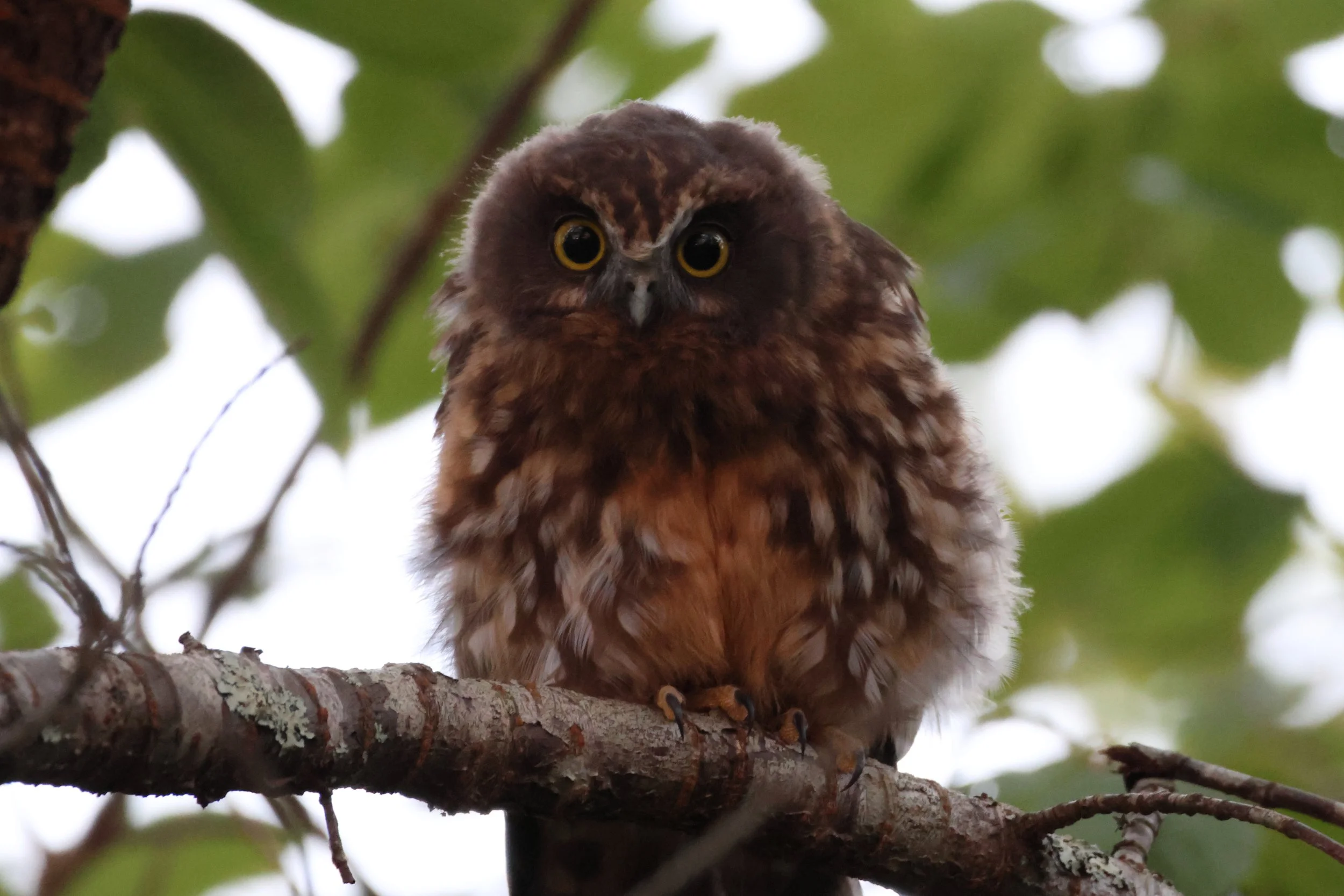
Morepork
On our way north to Kerikeri, we made a quick stop at the Waipu Wildlife Refuge along the Waipu River. We were quite fortunate to see two Australian Fairy Terns. There are thought to be only 35 fairy terns remaining in New Zealand. The species is also found in Australia and New Caledonia, but the New Zealand birds represent a distinct subspecies. Our last birding stop before checking into our hotel was Vinegar Lake. This suburban pond produced our only Australasian Grebes of the trip, along with New Zealand Grebe and Black Swan.
But our day wasn’t over quite yet! After dinner and a short rest, we headed back out to look for North Island Brown Kiwi. After hearing several calling in the night, we got decent looks at three individuals, including one that popped right out on the trail in front of us!
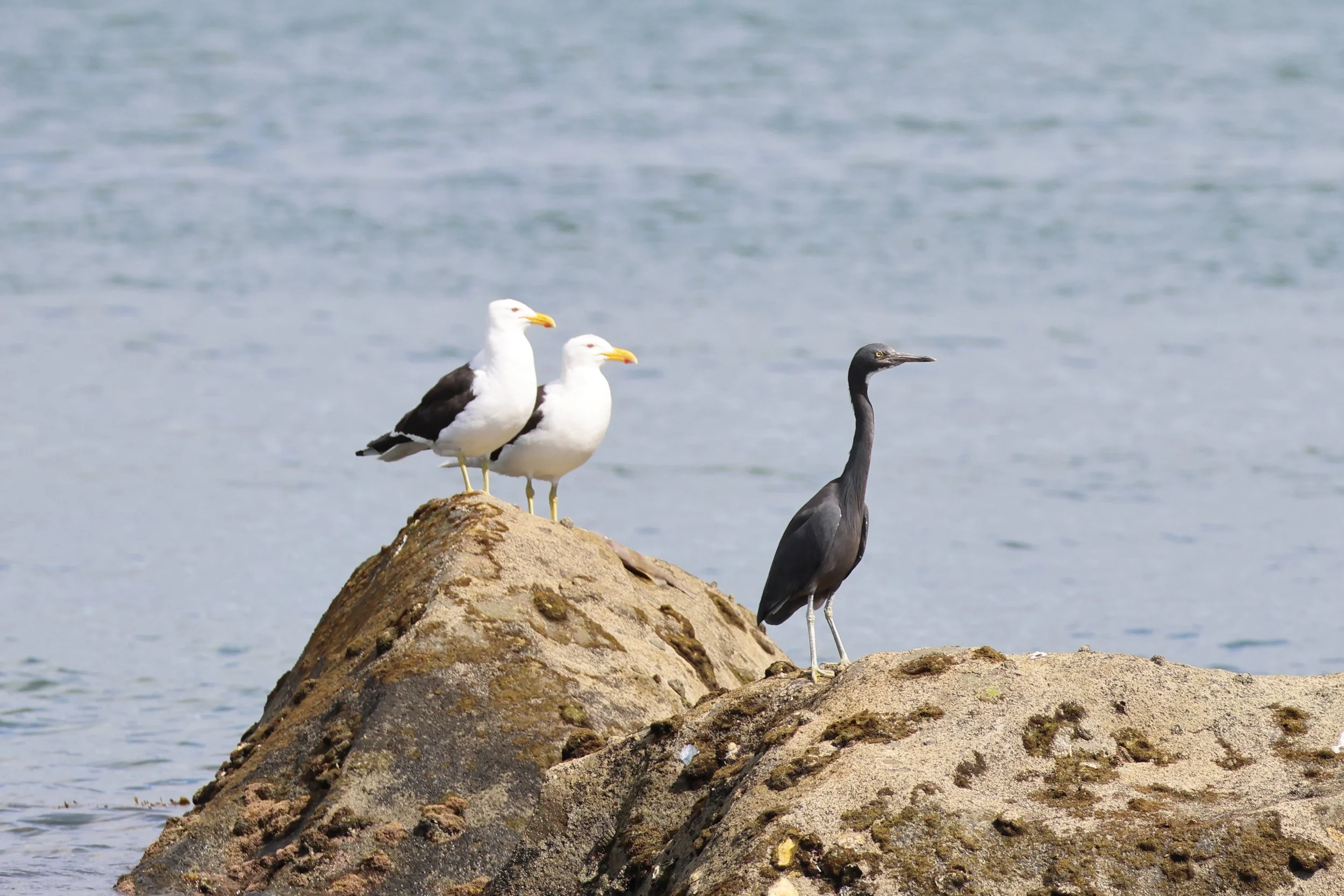
Pacific Reef-Heron
Day 2
Pelagic day! Today we enjoyed our first pelagic excursion of the trip out of Marsden Harbor with Captain Steve of Sumo Charters. This definitely ranks high as one of the most scenic pelagics - Hen and Chicken Islands, and the headlands of the harbor made a lovely backdrop for our trip. Many of the islands along the coast here host nesting seabirds, including Cook’s and Pycroft’s Petrels. The rocky shores of one small island hosted several Pacific Reef-Herons, our only sighting of this species the entire trip.
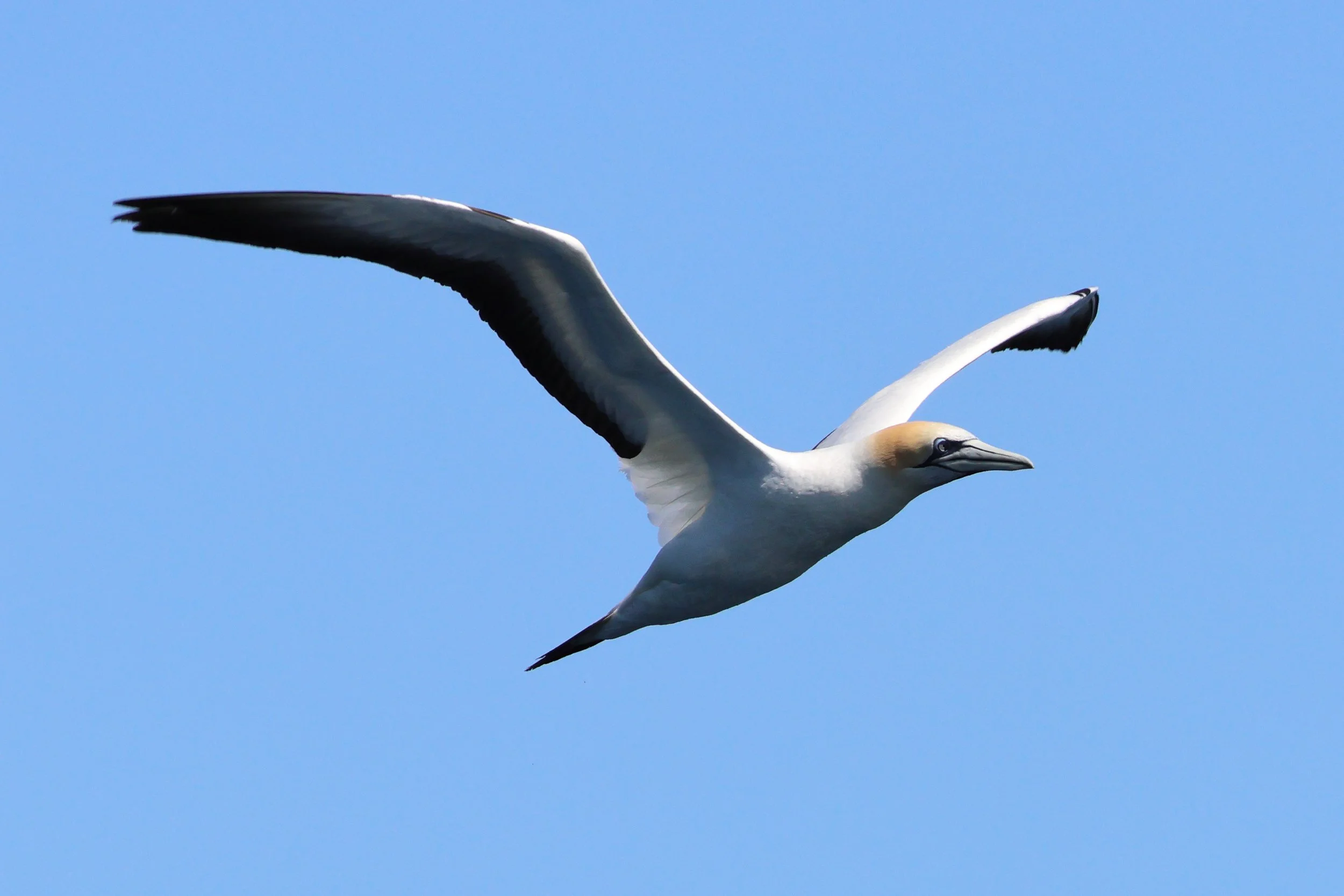
Australasian Gannet
Once we were out of the harbor and starting chumming, the pelagic sightings began in earnest. Fluttering, Flesh-footed, and Buller’s Shearwater were all quite common and took full advantage of our chum slick. Parkinson’s (Black) Petrel made frequent trips to the chum as well, allowing for easy comparisons to the nearby Flesh-footed Shearwaters. Cook’s Petrels kept their distance, but were fairly common. The very similar Pycroft’s Petrel was much scarcer and Brent worked hard to get us on several individuals. We also enjoyed numerous White-faced Storm-Petrels very close to the boat, but just a single New Zealand Storm-Petrel came into our slick. Nonetheless the New Zealand Stormy gave us great looks and we felt fortunate to see one. This rare endemic was thought to be extinct, until it was rediscovered by our guide Brent and fellow observers in 2003.
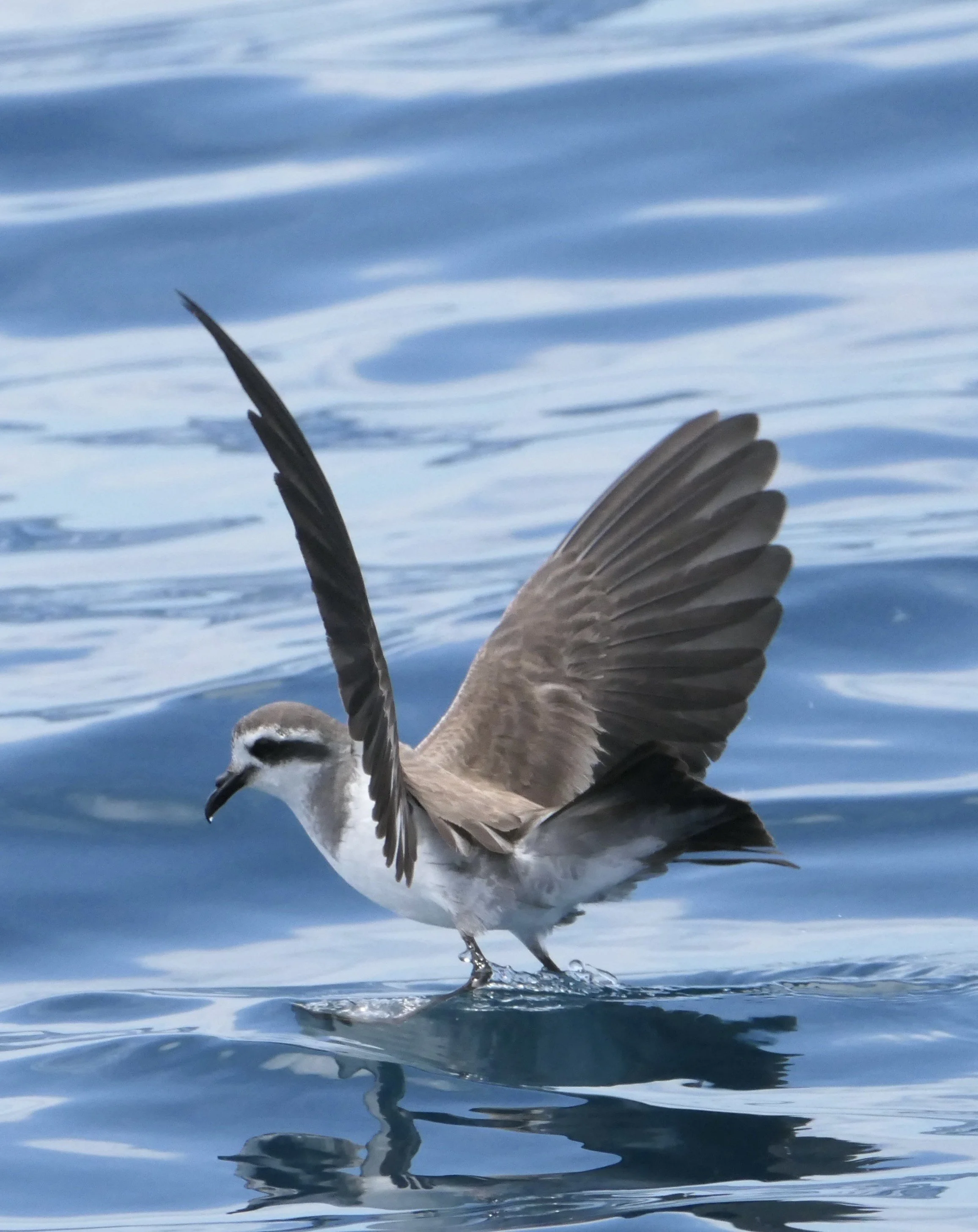
White-faced Storm-Petrel | Tom Pannabecker
Day 3
Today we headed back south, arriving at Gulf Harbour in time to catch a ferry to Tiritiri Matangi, a very popular and special destination for birders and tourists alike. Even though our time on the island was limited, we had the good fortune to see most of the island’s New Zealand endemics - North Island Kokako, Stichbird, New Zealand Fernbird, Red-crowned Parakeet, Rifleman, and Stitchbird. Stitchbird is the only living member of the family Notiomystidae and is found in only a few protected areas on the North Island. Its taxonomic relationships are uncertain, although it's clear that the similar honeyeaters (Meliphagidae) are not close relatives.
There was one last species we were hoping to see on Tititiri Matangi - the South Island Takahe. Only two pairs of Takahe reside on the island. At a certain age, the immature Takahe are captured and taken off island to help repopulate other protected areas. We very nearly missed seeing this rare species. We had a ferry to catch, but Brent decided to check just one last side trail. To our delight, a Takahe family was feeding right in the middle of the trail, only 50 feet from our group. The Takahe is the largest rail species in the world and the total population is only a few hundred individuals. The North Island Takahe went extinct in 1894.
After our usual bakery lunch, we headed south to Miranda. Shorebirds were extremely plentiful, including Wrybill, Double-banded Plover, Bar-tailed Godwit, and our first Black-billed Gulls (TJ’s 2,000th life bird!) of the trip.
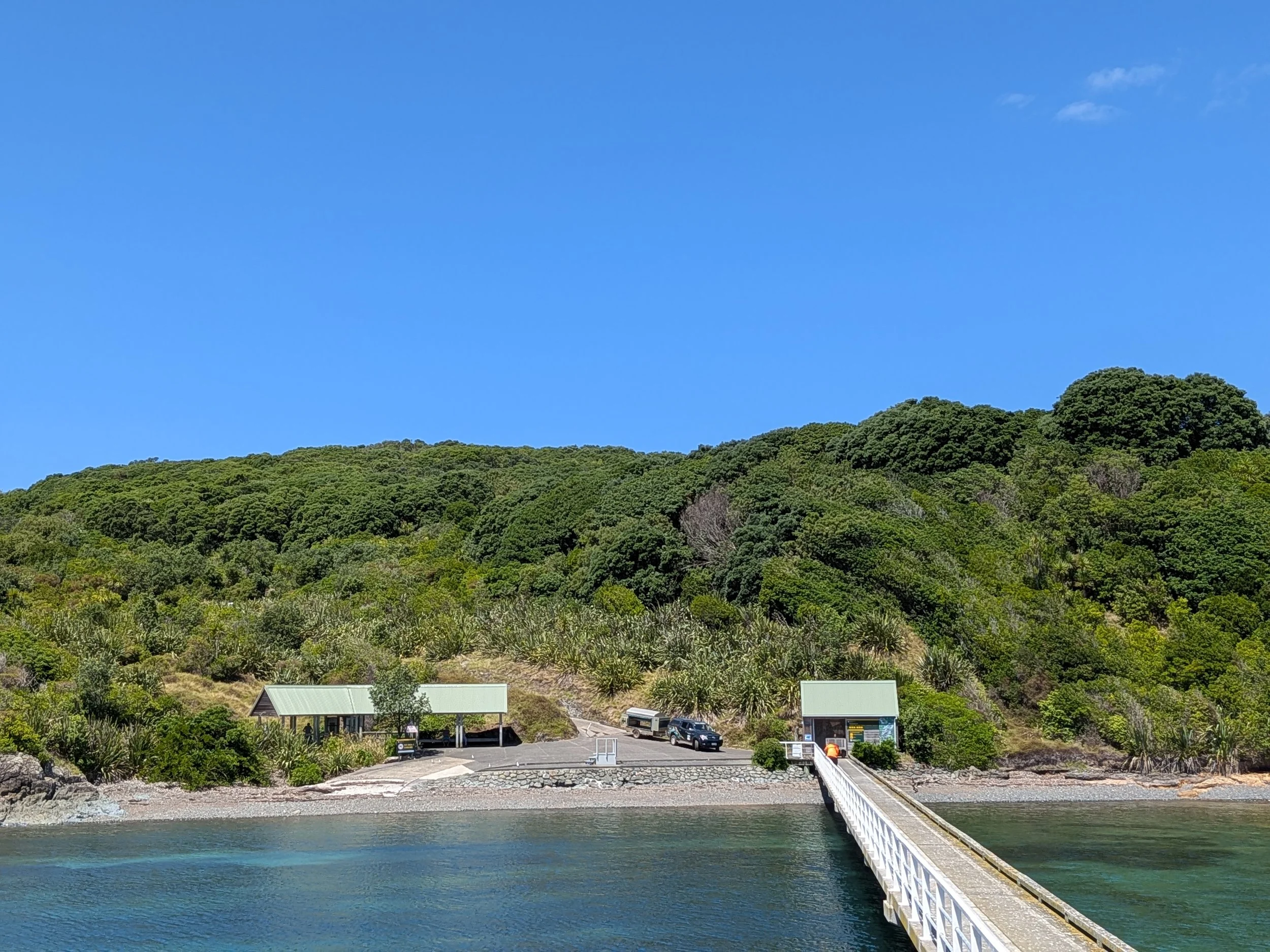
Tiritiri Matangi
Day 4
This morning we visited some productive shorebird spots in Robert Findlay Wildlife Refuge and the Piako Wader Roost. We got much better looks at large numbers of Wrybill, Double-banded Plover, Bar-tailed Godwit, and Pied Stilt. The Wrybill is the only shorebird whose bill bends to one side (the right!), an adaptation which allows it to easily probe under rocks. We also tallied an impressive total of six Sharp-tailed Sandpipers, a migrant to New Zealand. We had great looks at Gray Teal (dubbed “Devil’s Teal for its red eye) and our first Australasian Shovelers.
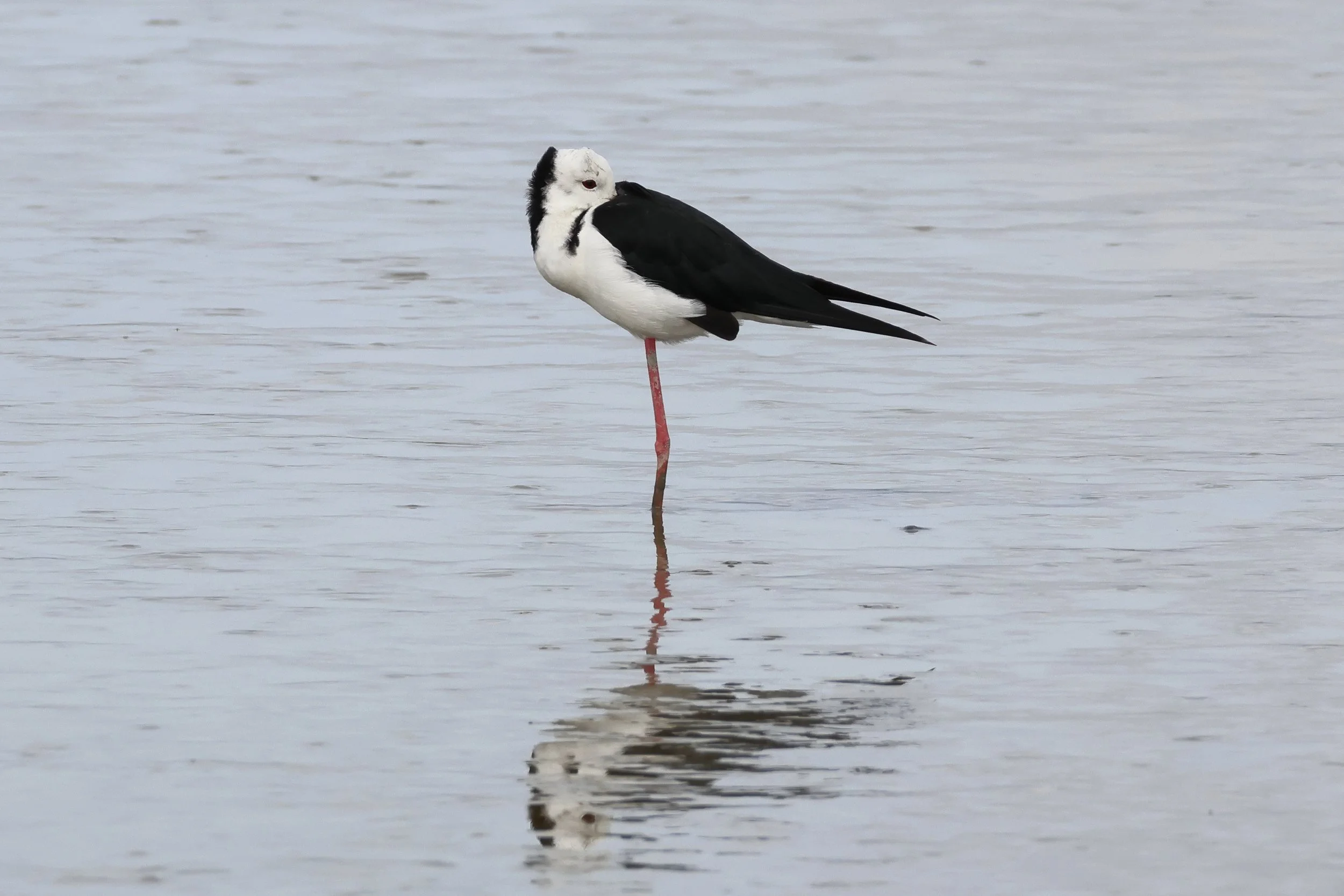
Pied Stilt
In the afternoon, a short stop at a marina offered us our first looks at New Zealand Scaup, Eurasian Coot, and Little Black Cormorant. A pair of New Zealand Grebe had some hitchhiking chicks riding their backs.
Day 5
Our destination today was Pureora Forest Park, but not before we searched some nearby side roads for some tricky target birds. Luck was on our side at our first stop, when a Long-tailed Koel (a migratory cuckoo) started calling and then flew right over us, giving us a decent view of this normally skulky bird. Several New Zealand Pipits were also quite cooperative as they fed along the edge of the road.
The rest of the morning, we enjoyed exploring the Pureora Forest. Although birds were hard to see inside the forest, we had a lovely walk through native, old-growth forest, with tree ferns, fuschia trees, lush beds of moss, liverworts, ferns, and huge, ancient trees. It was stunningly gorgeous and primeval. We observed our first Tomtit of the trip, a fleeting glimpse at a Rifleman, Yellow-crowned Parakeets and numerous Kaka and New Zealand Pigeons. A flyover New Zealand Falcon was a very exciting moment. We had been looking for this bird all morning, so anticipation levels were high when this raptor sped past us and into the forest. It proved to be our only New Zealand Falcon of the trip!
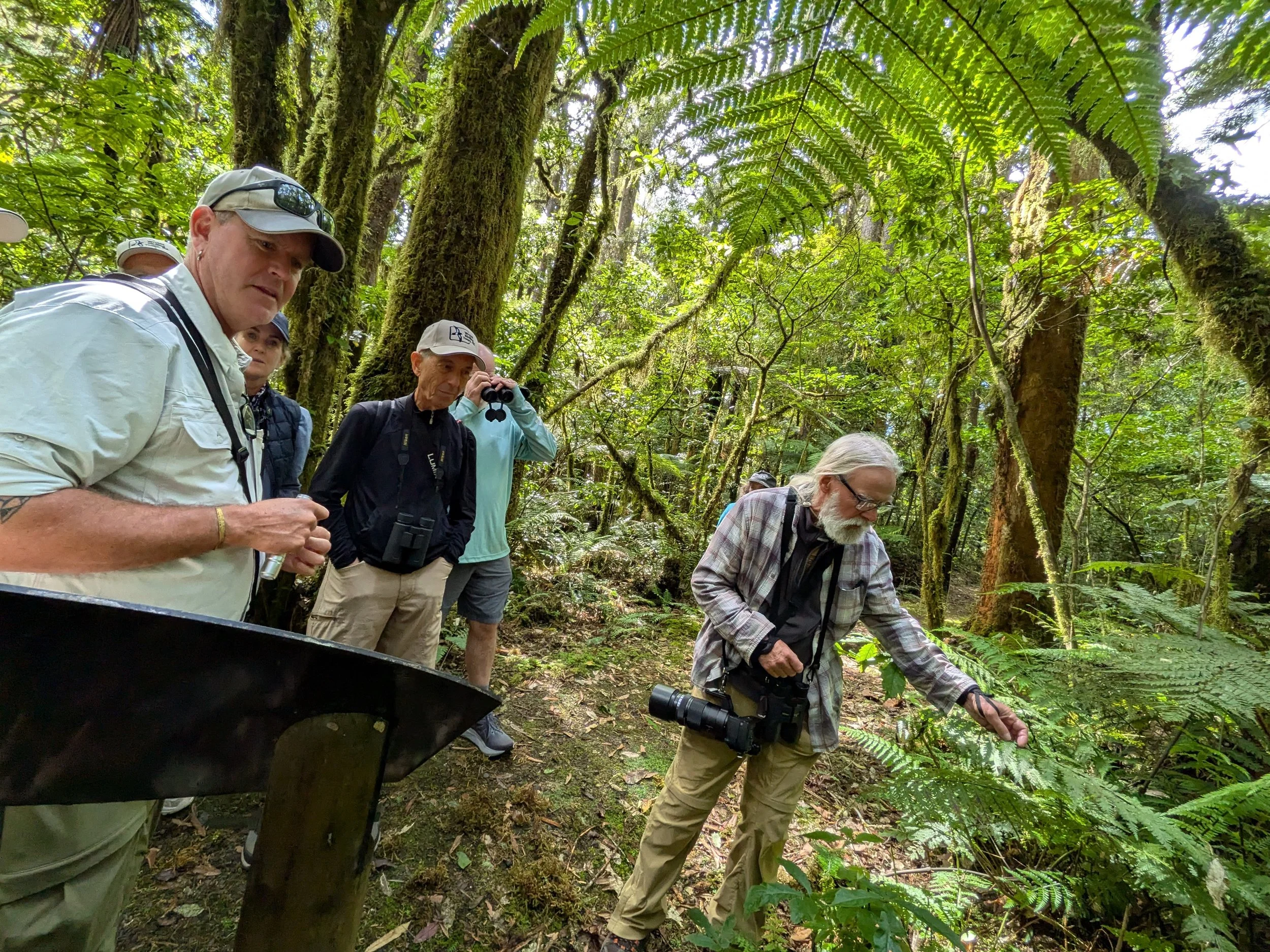
Exploring the Pureora Forest
A large part of the afternoon was devoted to looking for the enigmatic Blue Duck. This endemic species is only found on fast flowing rivers in New Zealand and is quite scarce. We were fortunate to find one lone adult male at our second stop. It was a cooperative individual and gave us excellent views as it clambered along a fallen tree and then swam downstream.
Later in the afternoon we tried hard for, and dipped on, Spotless Crake, although we did enjoy decent looks at New Zealand Fernbird and hundreds of Black Swan on Lake Taupo.
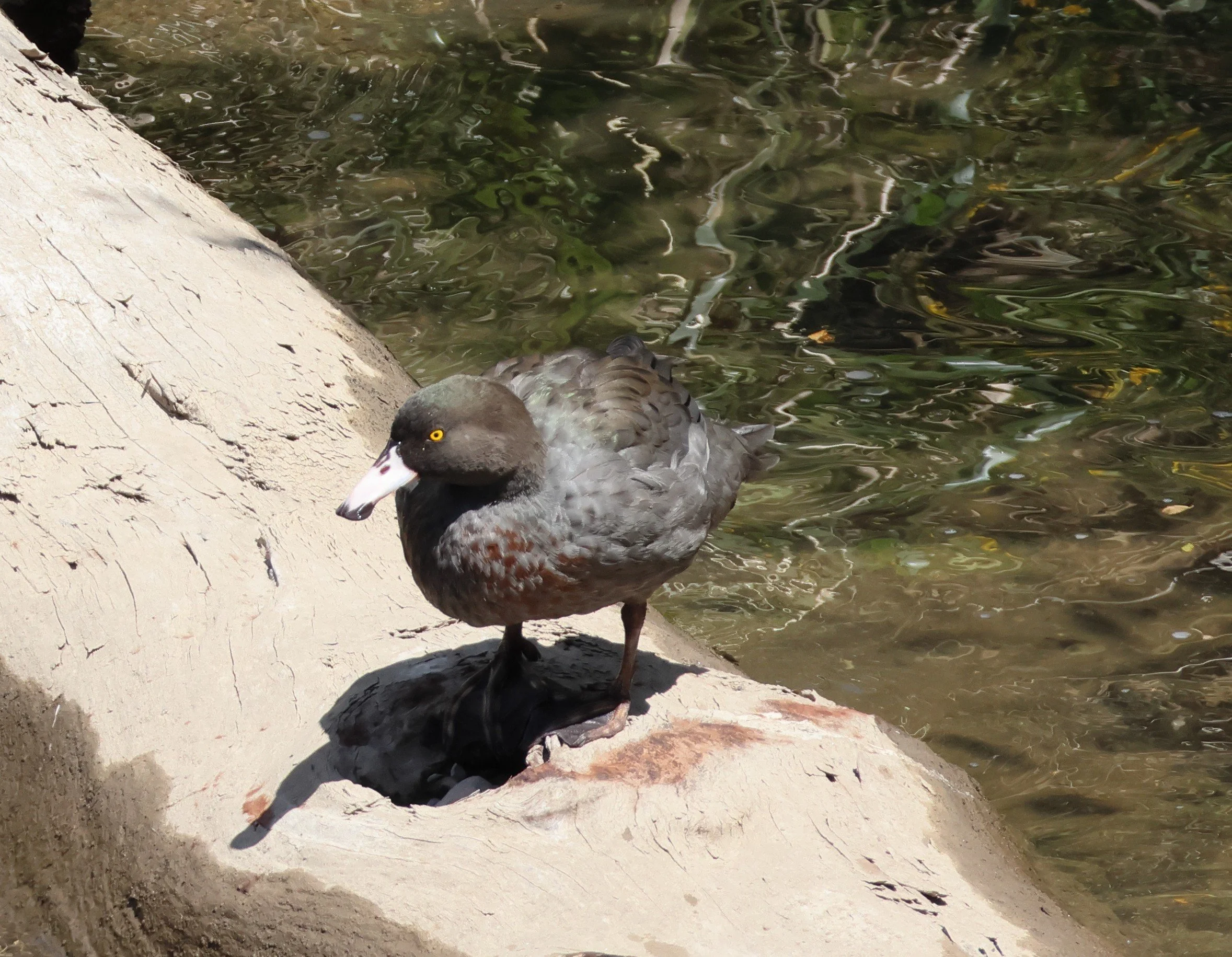
Blue Duck
Day 6
We had an early morning start today at the marsh at a good overlook to scan for Australasian Bittern, a very scarce species in New Zealand. We did manage fleeting glimpses of two individuals as they flew over the marsh and landed out of sight. We returned to the section of marsh we visited yesterday, and this time our attempt to find a Spotless Crake was successful. We didn’t see one, but one individual responded to our playback with a couple of “growls”.
With a long drive ahead of us, we hit the road early to be sure to catch our ferry, including an obligatory stop at a bakery for lunch. The ferry from Wellington on the North Island to Picton on the South Island is a journey of about 3.5 hours. The ferry boat is huge, accommodating buses, campers, and even tractor trailers. While often a good distance from the boat, we did see a wealth of seabirds on our crossing - White-capped Albatross, a single Buller’s Albatross, numerous Fluttering and Hutton’s Shearwaters, Fairy Prion, and Sooty and Flesh-footed Shearwaters. The Fairy Prions were especially entertaining to watch and they briefly landed on the surface of the water before taking off again.
As we approached the South Island and the mouth of Queen Charlotte Sound, we passed the tiny nesting islands of the New Zealand King Shag. This cormorant species has a highly restricted breeding range and the entire population number only about 700 individuals. Jaegers were plentiful as we cruised through the sound, primarily Parasitic, but a rare Pomarine also gave us a good show.
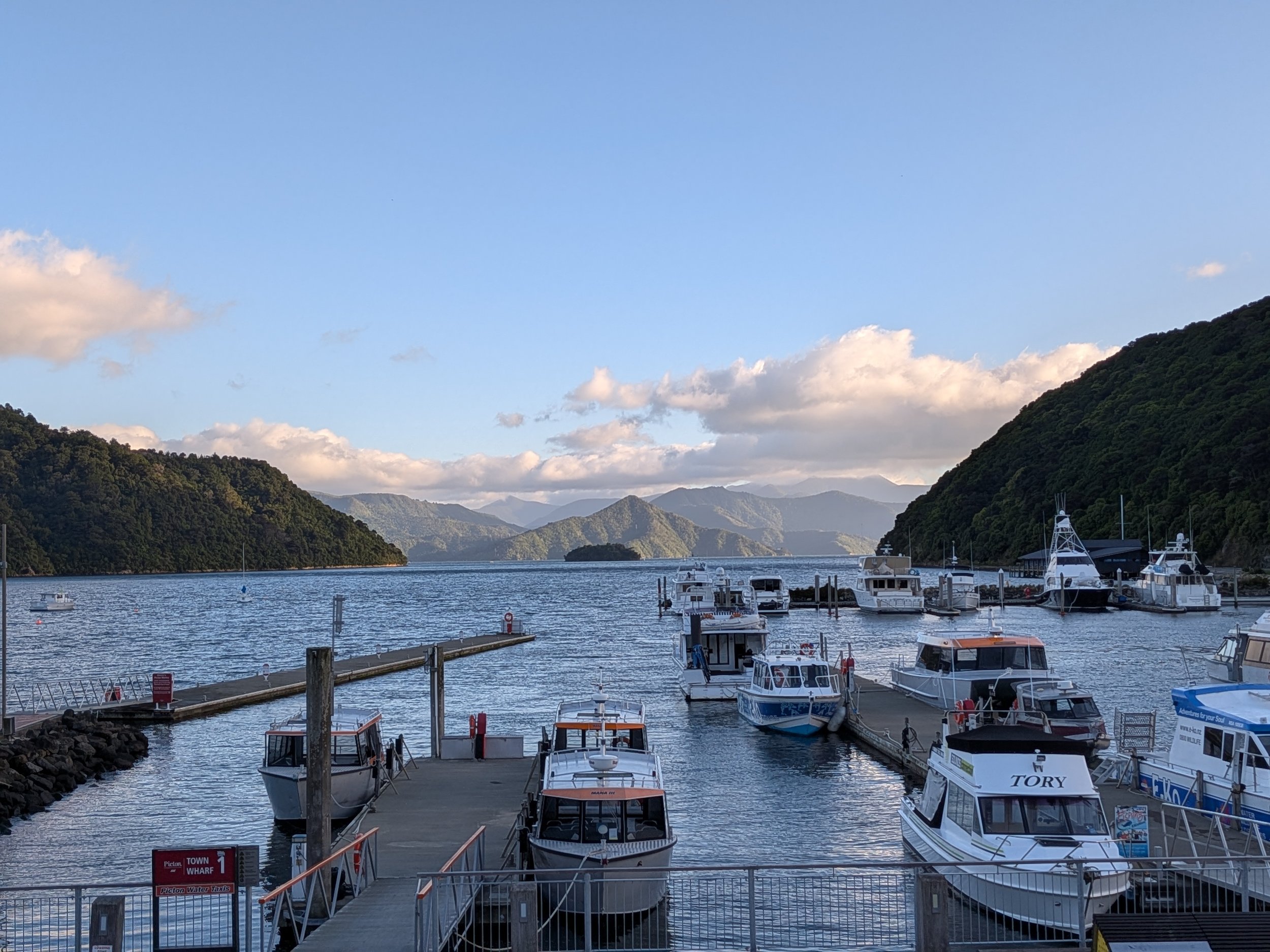
Picton Harbour, South Island
Day 7
We were back on the water again this morning. This time for a boat ride around Marlborough Sound out of Picton with Skipper Steve. Our next destination was Blumine Island, one of the few nesting sites in the country for Malherbe’s (Orange-fronted) Parakeet.
On the way, we cruised right up to a roosting group of New Zealand King Shag. We counted 43 individuals all together, representing a significant percentage of the world’s population. We were also treated to great looks at Hector’s Dolphin - the smallest oceanic dolphin in the world, just over one meter in length. We saw several with their black, rounded “Mickey Mouse” dorsal fins.
Some Variable Oystercatchers greeted us as we made landfall on the beach on Blumine Island and we immediately headed up the trail to look for parakeets. It didn’t take long before we found a pair of Malherbe’s, but not everyone managed to get on them. We spent a good deal of time trying to relocate them with no luck - although a Weka, a Tomtit, a slew of Silvereye, several Bellbirds and a few New Zealand Pigeons entertained us while we looked. Finally, just as our time on the island was coming to a close, a lone parakeet flew in close to the group and started to bathe in the creek!
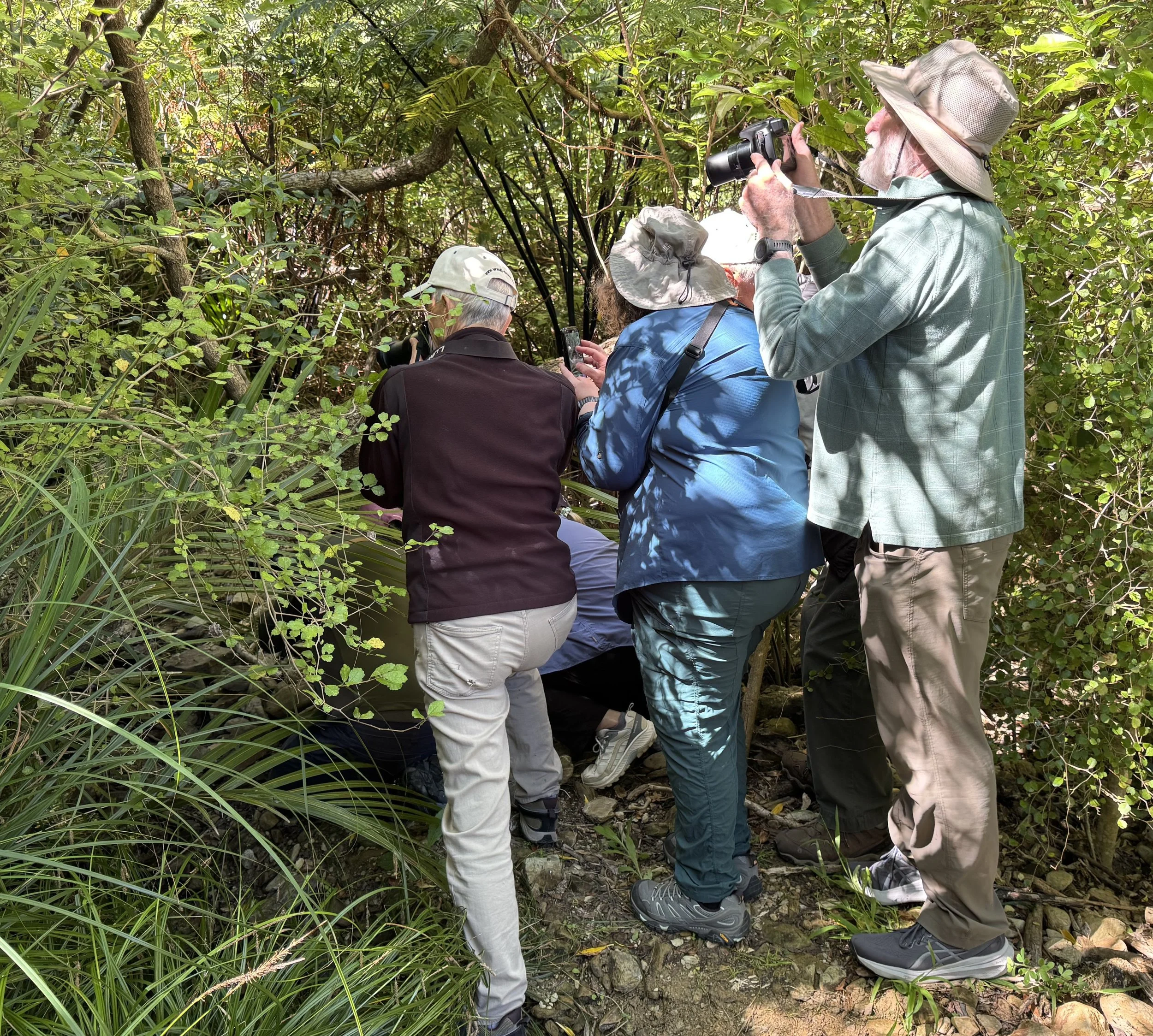
Angling for a photo of the rare Malherbe’s (Orange-fronted) Parakeet
Our next destination was the town of Kaikouri on the east coast to the south of Picton, with a couple of birding (and mammal) stops along the way. At Lake Elterwater we observed several Hoary-headed Grebes. This species was first recorded breeding in New Zealand at this location in 2018.After checking into the Alpine View Motel, and a terrific fish and chips picnic dinner, we went for a short drive in search of Little Owl. Perhaps one of the more surprising of New Zealand’s introduced birds, the owls can be fairly easy to find in the early evening. It didn’t take long before Brent spotted one nestled in the framing of a rundown house. These owls are often very skittish, but this individual allowed us all to get out of the van and get great scope looks.
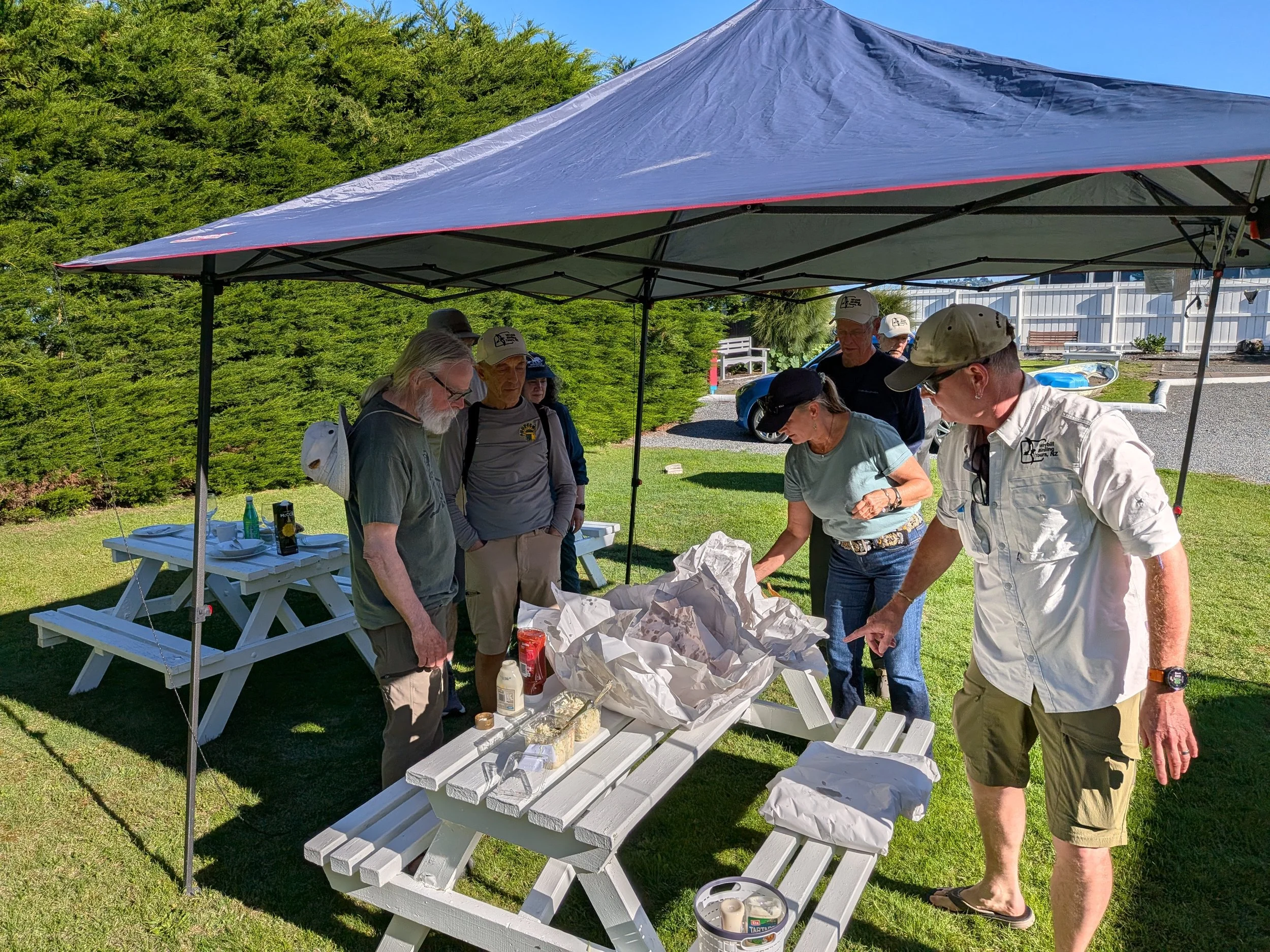
Fish & chips picnic in Kaikouri
Day 8
A very rainy day today and, unfortunately, our pelagic out of Kaikoura was cancelled, as were all the afternoon excursions. After consoling ourselves with coffee, pastries, and souvenir shopping, we drove a ways down the coast and enjoyed observing a couple pods of Dusky Dolphins. One pod was quite close to shore and put on a wonderful show, jumping and leaping out of the ocean. When the rain stopped for a period, we also stopped at a roadside pull-off to seawatch. Seabirds were plentiful but quite distant. We did manage to identify a few species including Hutton’s Shearwater, White-capped Albatross, and our first Antipodean Albatross.
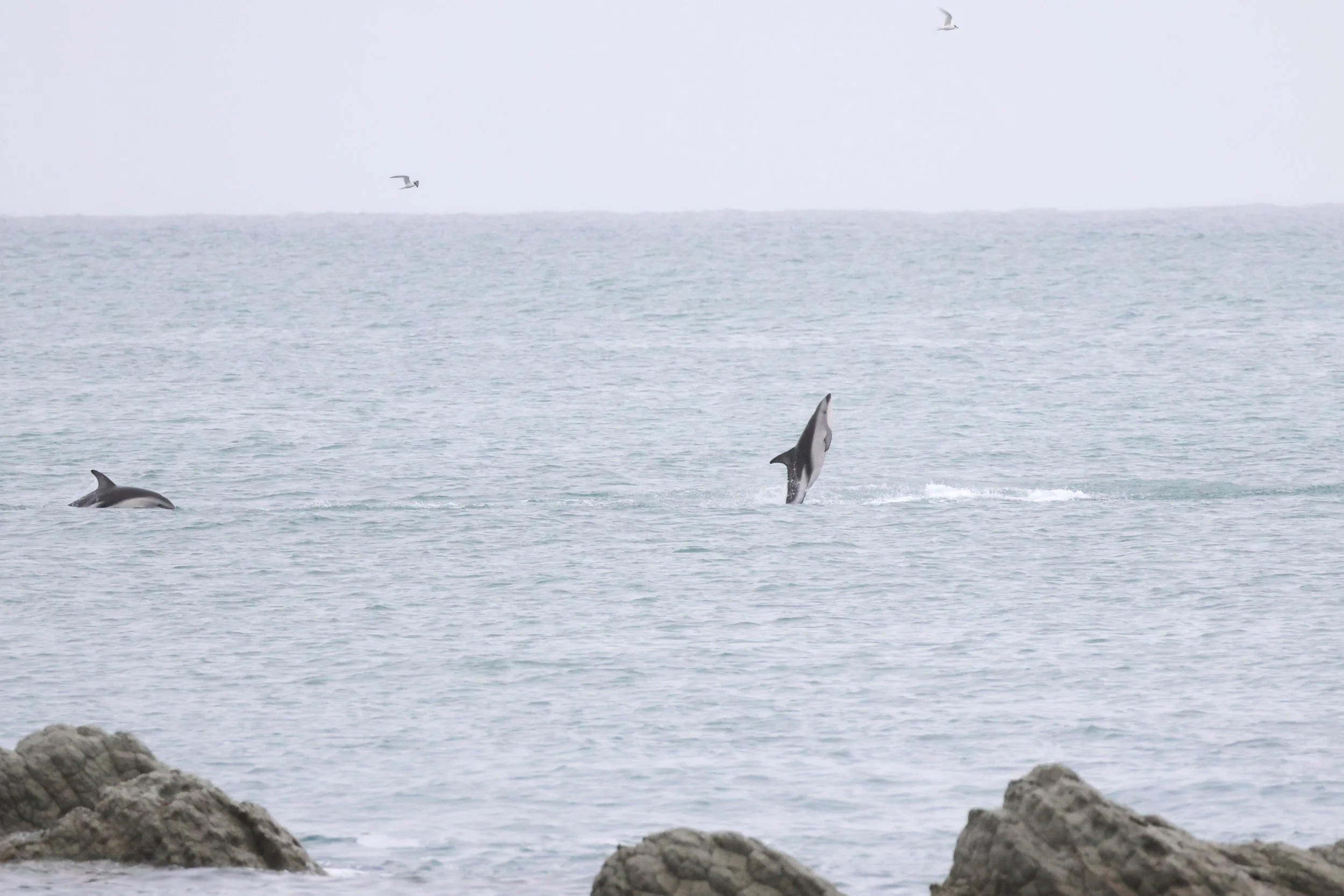
A pod of Dusky Dolphins
Day 9
After a very rainy day and very few birds, it was great to be out birding in the sunshine again. There was still some misty drizzle at the start of the day, but our seawatching from shore was very successful. We tallied three species of albatross, mostly Savin’s and White-capped, but also two Antipodean (New Zealand Wandering) Albatross, of the Gibson’s subspecies. Northern Giant-Petrel, Westland Petrel, and Hutton’s Shearwater were also spotted, making for a very productive session.
We continued our drive south, stopping at Ashley Creek Estuary to look for terns and shorebirds. Brent spotted our first Black-fronted Tern of the trip and Bar-tailed Godwit, Royal Spoonbill, and Double-banded Plover were plentiful on the mudflats. A Little Egret, perhaps one of just two in the whole country at the time, gave us a brief look before dropping into the marsh. Our good luck continued when just down the road Brent spotted a pair of Mute Swan. And eagle-eyed Linda soon upped the ante when she spotted a Cape Barren Goose in the same field! Our search for a vagrant Maned Duck at a local golf course was unsuccessful, but lucky streaks can continue only so long!
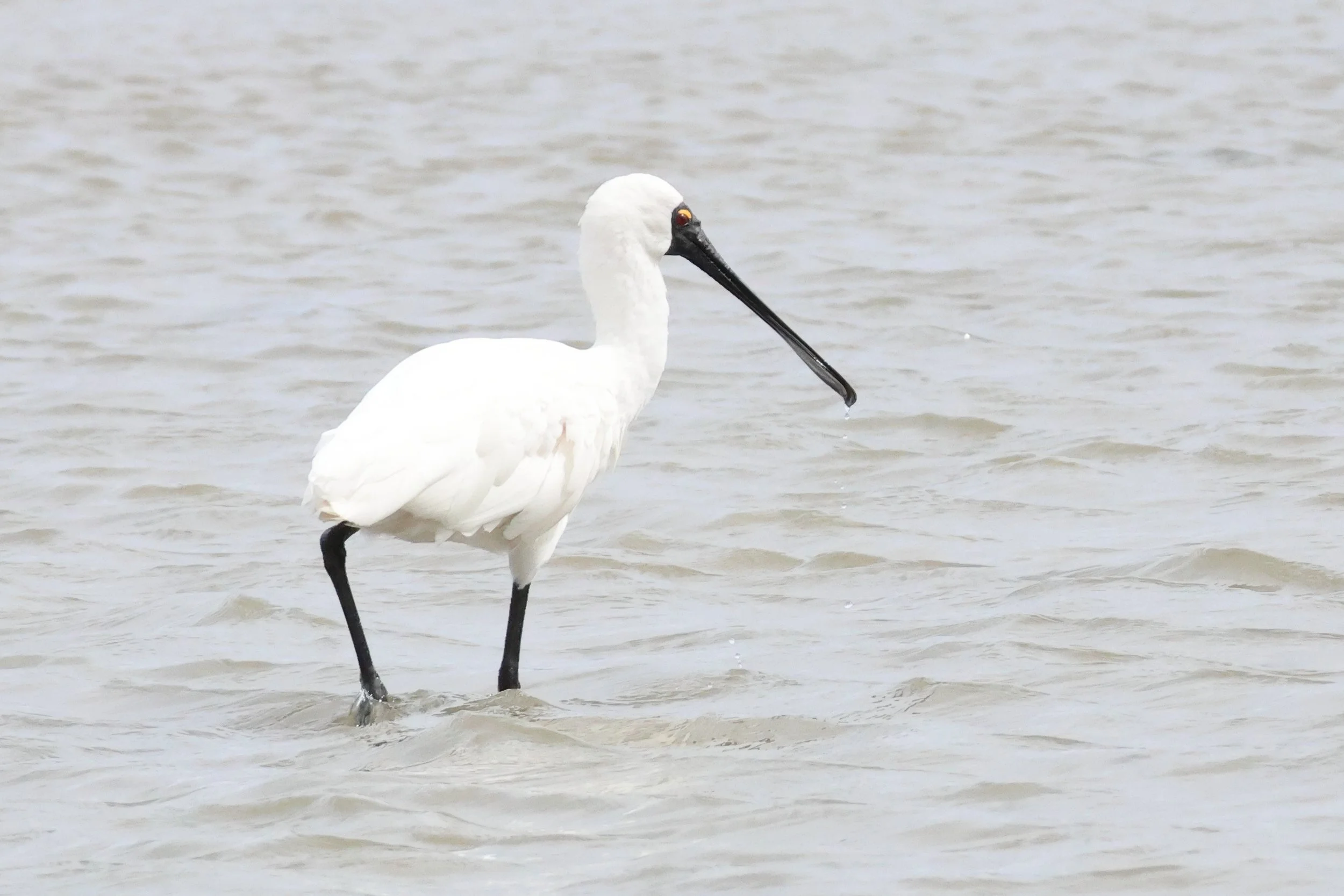
Royal Spoonbill
After lunch we began our drive up into the mountains and to the village of Arthur’s Pass. Our primary goal was finding Kea in the area and we first looked for the rare parrot at a spectacular overlook high above town. At our next stop, right in the village, a South Island Robin lured us into a parking area with its distinctive song. We couldn’t find the robin, but we soon heard an immature Kea in a tree, hidden from view until we spotted it in the subcanopy. As we watched and photographed the Kea, one of its parents came waddling straight towards our group. It walked right past us, into the forest, and up into the trees where it joined its calling offspring!
After dinner and a short rest, a few members of the group headed out for Kiwi search #2. While we were waiting in the van for the skies to darken up, much to our surprise, a Greater Spotted Kiwi female started calling! We tumbled out of the van as quickly as we could, but unfortunately the Kiwi clammed up. Despite a thorough search and a slow walk along the trail we couldn’t relocate the Kiwi. We did, however, hear Morepork calling and enjoyed an impromptu stargazing session. The Southern Cross was prominent low in the sky, and Chip pointed out the Large Magellanic Cloud, a dwarf galaxy and neighbor to the Milky Way.
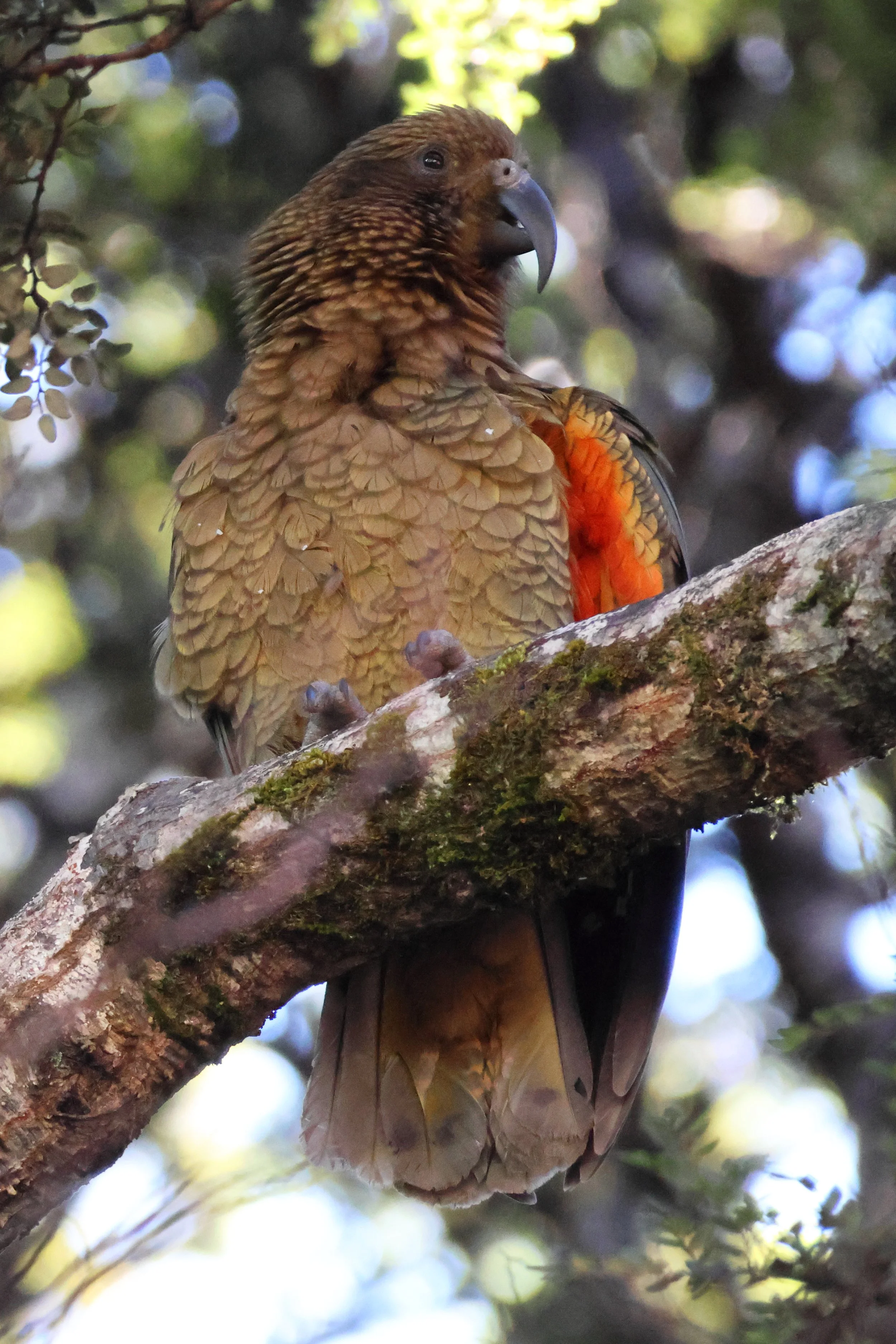
Juvenile Kea at Arthur’s Pass
Day 10
After a late night, we had a more leisurely start to the day, with a nice walk in native beech forest outside of Arthur’s Pass. We had our best looks at Riflemen (a member of the endemic New Zealand Wren family), Tomtit, and a very obliging South Island Robin hopping around our feet.
No day would be complete without lunch from a local bakery and today’s stop was in Fairlei for their famous meat pies. The afternoon was dedicated to searching for Black Stilt in the Lake Takepo region. No Stilts were to be found on the enticingly-named “Stilt Road”, but we hit the jackpot at another nearby location, where we saw a total of eight Black Stilts. With a total of just over 100 adults, those eight represented a significant percentage of the worldwide population. While Pied Stilt has become an increasingly common species, Black Stilts are found only in a very small region of the South Island. The species was on the verge of extinction, but rebounded by a small degree with very active management. Predators, such as weasels and cats, continue to be a major problem and the population would certainly nose dive without predator control and other conservation measures.
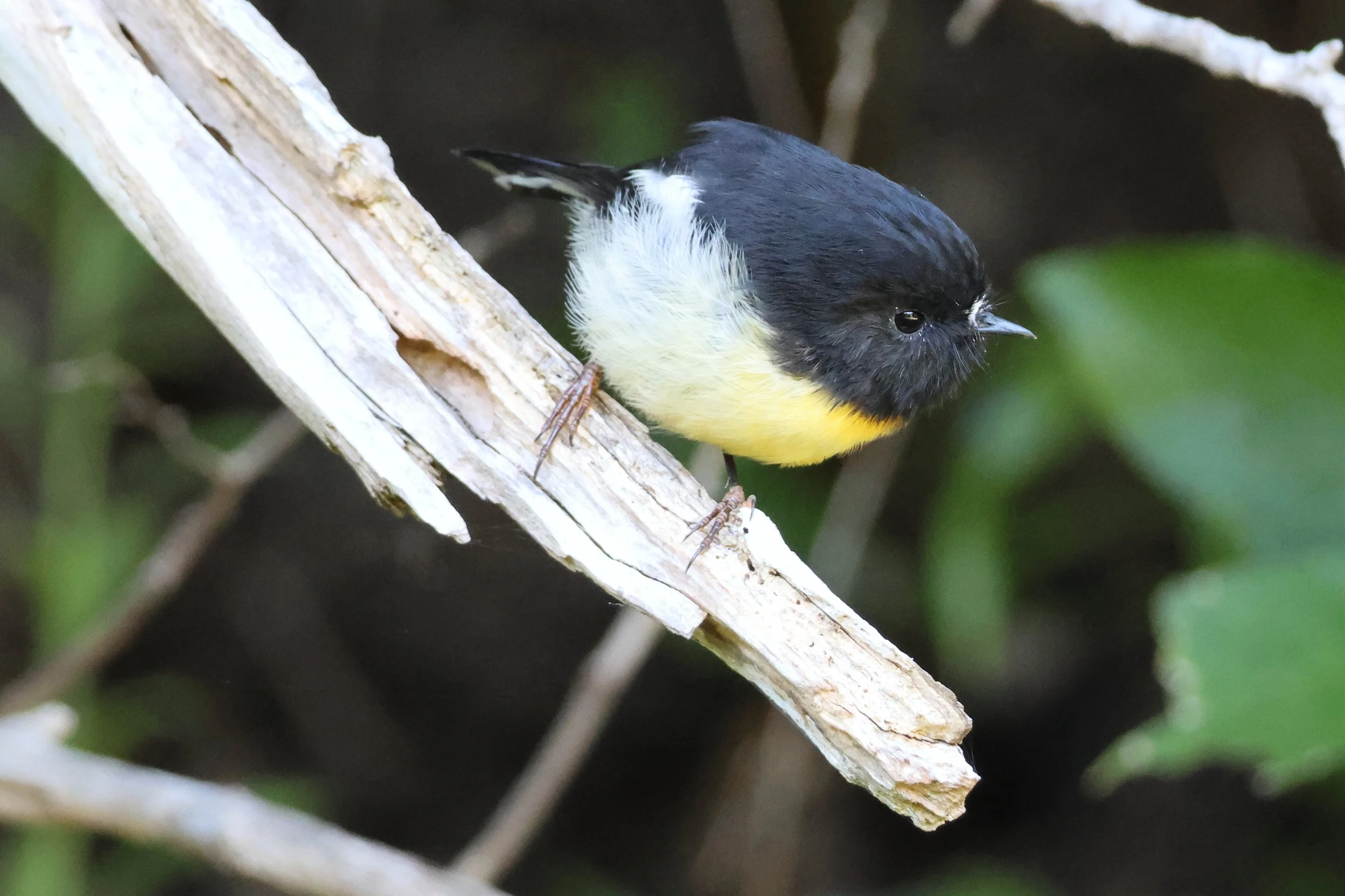
Tomtit
Day 11
Penguin day! What a day for us and our tuxedo-clad friends. Brent received a hot tip about a rare penguin at Second Beach in Oamaru and, after a rigorous hike to the beach, we scored three different species of penguin. The first species was a couple of Little Penguins in wood-framed burrows in the side of the hill. Previously we had only seen Little Penguin on the water where they looked like small, floating logs. Although they were tucked away in their burrows we could see their yellow eyes and chunky beaks.
After a short hike on a slippery shingle beach, while trying to avoid disturbing the nearby New Zealand Fur Seals, we enjoyed our second species - a rare Erect-crested Penguin. This species is normally seen about 100 miles further south, where they nest on sub-Antarctic islands. Occasionally, during their annual molt, this species is seen further north. They remain on land at this stage, since they are very vulnerable in the water. A little further up the beach we found our third penguin taking shelter in a small cave - a Fiordland Penguin. This is a species we were only expecting to see further south around Stewart Island.
Our next stop secured us our fourth and fifth species of penguin. The refuge at Kakiti Point is a known colony of Yellow-eyed Penguin and a popular tourist destination. This is another rare species with perhaps only 100 pairs on the South Island. We saw two individuals come out of the ocean and march up the beach to the hillside vegetation where they nest. We spotted another one amongst the bushes before it disappeared from view. And last, but certainly not least - penguin #5 - a rare Snares Penguin, which was hunkered down amongst the rocks at the base of a sea cliff. We could only see the head poking up, but it was thrilling to glimpse this species which nests on only a couple of sub-Antarctic islands. It was the first time Wrybill Tours has recorded five species of penguin in a single day!
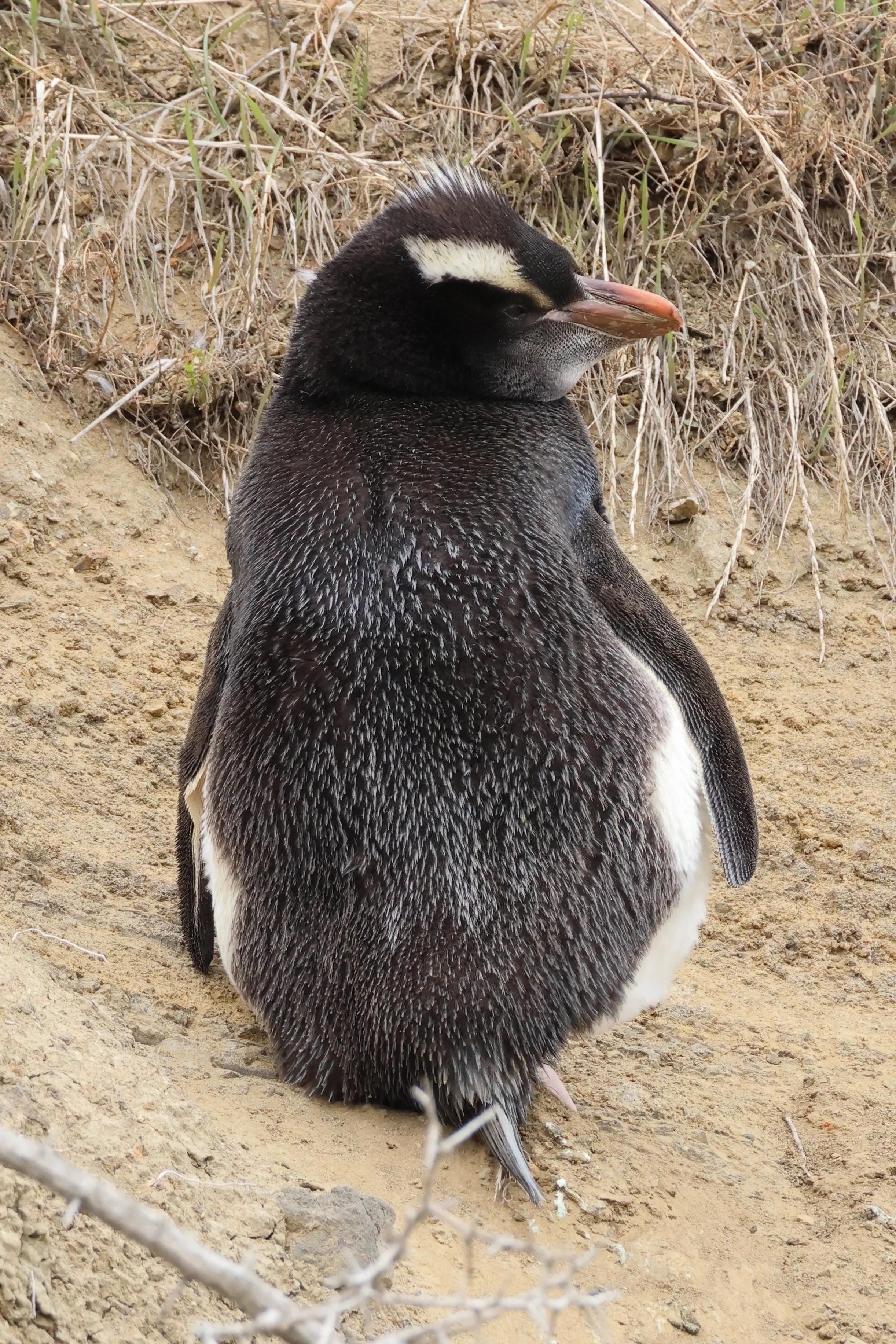
Erect-crested Penguin
Day 12
Today was mostly a travel day from Oamaru to Bluff to catch the ferry to Steward Island but, of course, we made a couple of birding stops to break up the trip. Our first birding stop was to view the Northern Royal Albatross colony on Taiaroa Head. Approximately 70 pairs of Northern Royals nest here, the only mainland albatross nesting colony in the world. We viewed the colony from across the bay, but could see large numbers of albatross sitting on nests on the grassy slopes. Our next stop was the Sinclair Wetlands, where we tried for Baillon’s Crake, the official nemesis bird of the trip. The crake eluded us yet again, but we had great looks at New Zealand Fernbird and an Eurasian Stoat (Eurasian Ermine) in the wetlands.
The ferry ride across the Foveaux Straight from Bluff to Stewart Island was quite “sporty” as the captain put it. There were quite a few seabirds, but with the rocking of the boat, the crashing waves, and the spray, it was quite challenging to get good (or any!) views. We did see Sooty Shearwaters, White-capped, Salvin’s, and Buller’s Albatrosses, and Brent also called out Pintado, Cook’s, and Mottled Petrels. Those birds remained “Brent only” birds, at least until later in the trip. We did prove, however, that our group had stronger stomachs than the German tourists on the boat!
After checking into our hotel and a lovely dinner, we had one more mission for the day. Although our beds beckoned, at 10 p.m. we headed to the local airstrip to look for Southern Brown Kiwi. We were not disappointed! As we walked the length of the airstrip, we observed a grand total of eight Southern Brown Kiwis - some paired up, a couple of bachelor males, and even juvenile Kiwi. One young male was incredibly curious and came right over to our group, even bumping against Jim. After a couple of sniffs, our new Kiwi friend ran off in a hurry!
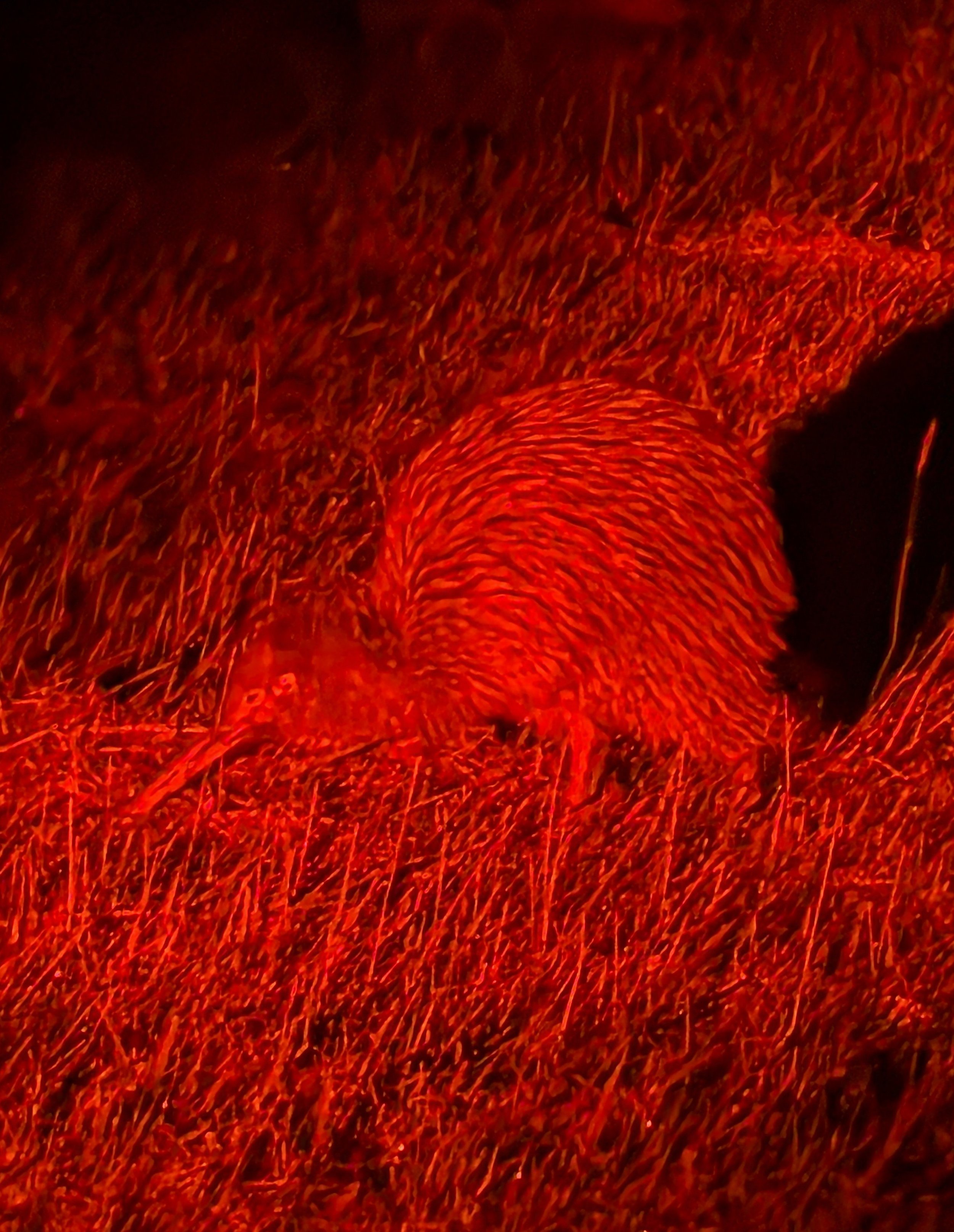
Southern Brown Kiwi
Day 13
Our last full day of birding in New Zealand and what a great final day it was! In the morning we headed to Ulva Island, where we walked the forest trails and sandy beaches. We observed two more species in Mohouidae (the Whitehead family), Pipipi (also known locally as Brown Creeper) and Yellowhead, both in good numbers and very close. We also had great encounters with Weka on the beach. A family group of this flightless rail species, all foraging along the beach, barely paid us any notice. We also had unobstructed looks at South Island Saddleback from the beach and great looks at a very cooperative Red-fronted Parakeet.
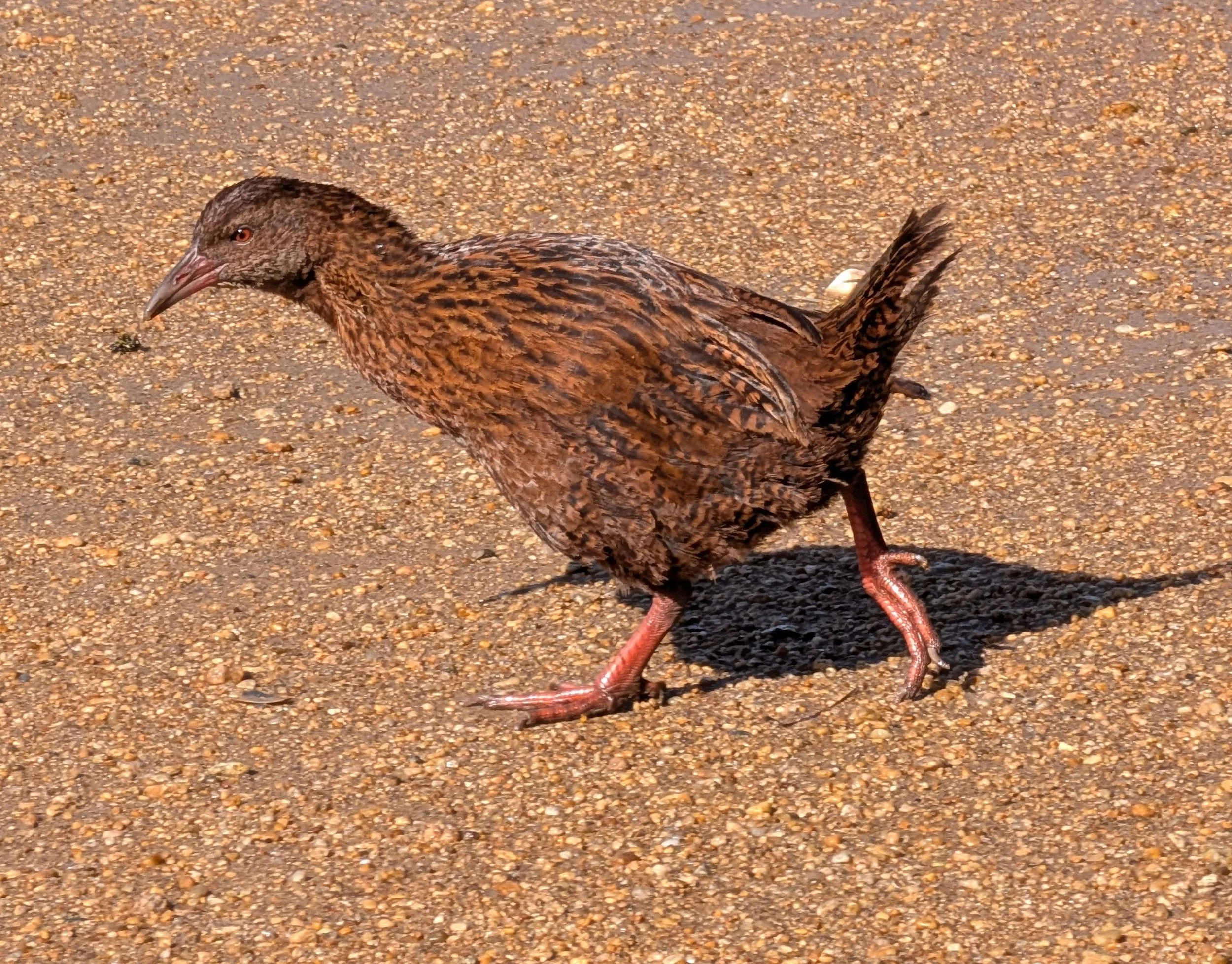
Weka on the beach on Ulva Island
Our final pelagic of the trip was phenomenal, with five species of albatross, three species of storm-petrel and a healthy serving of shearwaters and petrels - as well as perfect weather and seas! The Antipodean (Gibson’s) Albatross was the biggest surprise, being far from its usual haunts. Mottled Petrel was also an uncommon find, as this species is not seen on every pelagic out of Stewart. Pintado Petrels were constant companions on the boat ride, as were White-capped Albatross. We also enjoyed a White-chinned Petrel, our only one of the trip. We were also introduced to the friendly neighborhood Brown Skua, which caught pieces of Blue Cod thrown in the air by our captain!
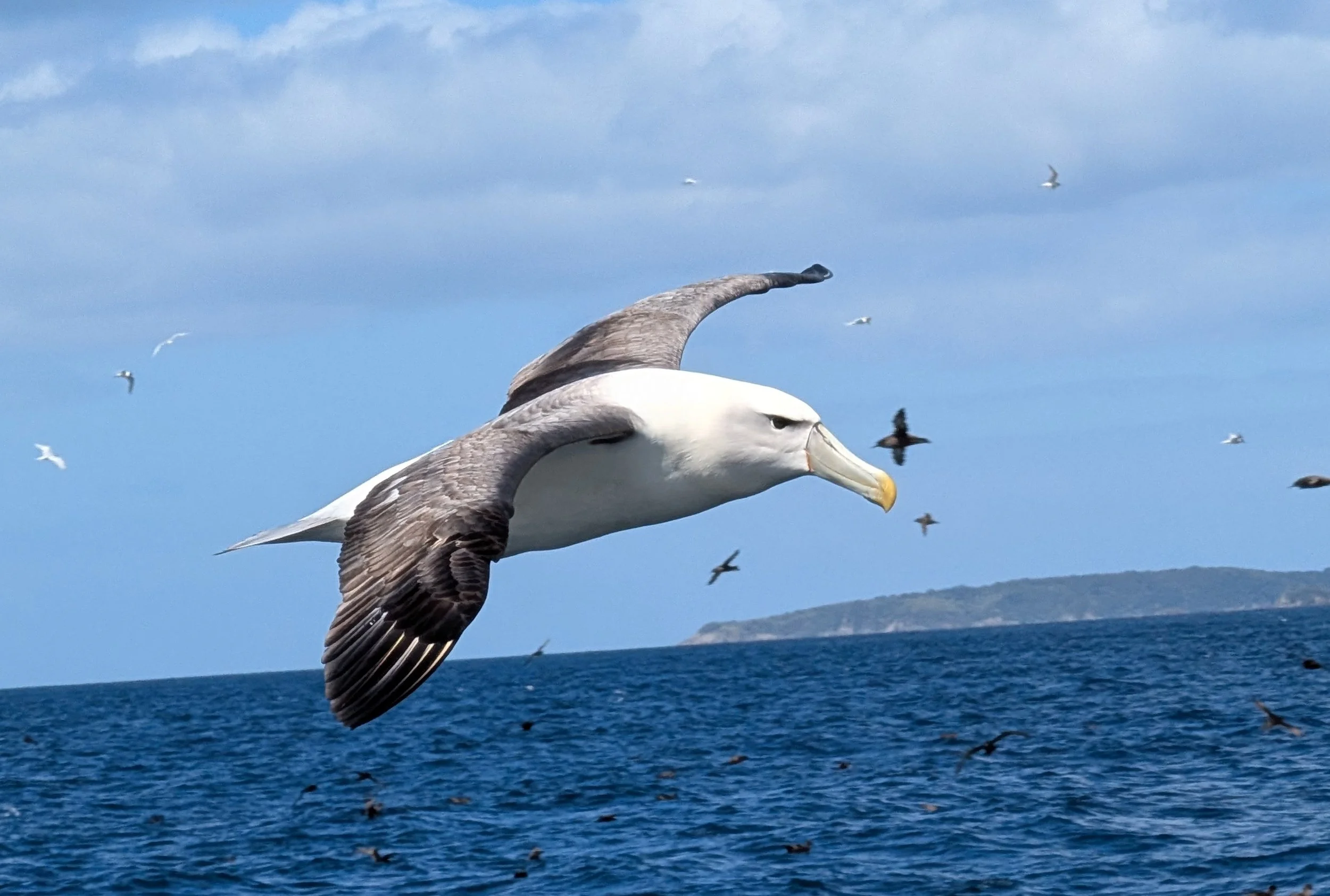
White-capped Albatross
Day 14
Homeward bound today. We caught the ferry from Stewart Island back to Bluff, our last opportunity for some seabirding. We had some final looks at White-capped Albatross, plenty of Sooty Shearwaters, several Common Diving-Petrels, and a final Mottled Petrel. The seas were much calmer than our last crossing, so we were also able to enjoy the view!
In total we recorded 146 species for the trip, a record for Wrybill Birding Tours for a 2 week tour. We observed representatives of six different endemic bird families - Kiwis (Apterygidae), New Zealand Parrots (Strigopidae), Whiteheads (Mohouidae), Wattlebirds (Callaeidae), Stitchbird (Notiomystidae), and New Zealand Wrens (Acanthisittidae). We drove a whopping 2,300 miles, from Kerikeri on the North Island to Stewart Island at approx. 47° S latitude!
OR…